
Large power equipment only proves itself under real electrical stress. A diesel generator rated at 2 MW cannot be validated by a nameplate reading, a no-load voltage check, or a brief 30% load walk; switchgear, busbars, transformers, UPS systems and rectifier banks all behave differently once thousands of amps begin to flow through them. This is the gap that a high current load bank fills. It converts electrical energy into heat on demand, in a controlled, repeatable, measurable way, so that commissioning engineers, test laboratories and maintenance teams can see how equipment behaves at 100% load, at overload, at leading and lagging power factor, and after hours of continuous duty.
As a technical engineering team working exclusively in the load bank segment, we design and build high current load banks for facilities that cannot afford a failed acceptance test. Below is a structured look at the eight platforms in our current lineup, the engineering logic behind each one, and the selection criteria we apply when matching a load bank to a specific piece of large power equipment.
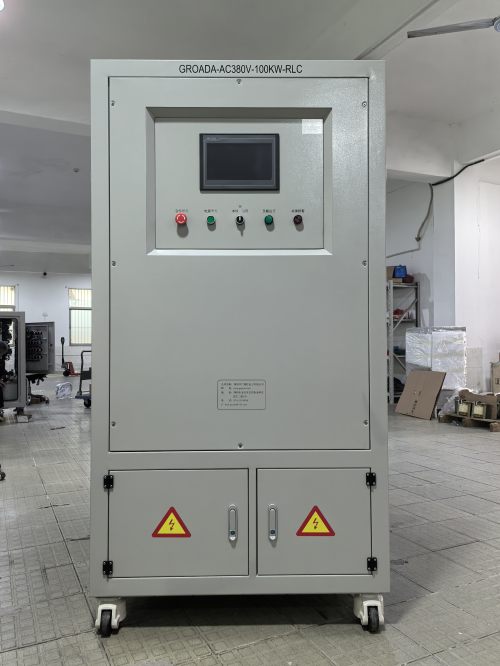
Why High Current Testing Is Different From Ordinary Load Testing
Low-voltage bench testing with a few hundred amps is a routine exercise. High current testing at 3,000 A, 10,000 A or 25,000 A is a different discipline entirely. Three factors change:
- Conductor and contact heating. Heat generation rises with the square of current. At 10,000 A, a joint with 20 micro-ohms of excess resistance dissipates 2 kW as pure local heating. Load testing exposes these defects before they become field failures.
- Magnetic forces and mechanical stress. High current busbars experience substantial electromagnetic forces during faults and transients. Only a load bank that can deliver a genuine high-current step will reveal whether the mechanical bracing and terminal torque are adequate.
- Thermal time constants. Transformers, generators and cables all have long thermal time constants. Meaningful detection requires steady-state loading sustained for hours, not seconds. Duty cycle and cooling architecture therefore matter as much as the current rating.
A load bank built for high current service must be engineered around copper cross-section, contact resistance, forced-air or liquid cooling, and a protection strategy that fails safe. It is not a resistive heater in a cabinet.
Selection Criteria We Apply Before Recommending a Model
Before narrowing down to one of the eight platforms, we work through six parameters with the customer:
- Rated current and voltage window. The required test current and the range of voltages the equipment runs at. A load bank must reach rated current at minimum voltage, which drives cable and element design.
- Power factor requirement. Resistive-only testing validates thermal capacity; resistive-inductive testing validates voltage regulation, excitation response and engine governor behaviour. Generator acceptance tests per IEEE and ISO practice usually call for 0.8 PF.
- Duty cycle. Continuous, intermittent or short-time. Continuous duty demands conservative element watt density and oversized cooling.
- Cooling and installation. Indoor air-cooled units need ducting and heat rejection planning; outdoor containerised units need only pad space and power connections.
- Control and data capture. Manual step switching, PLC control, remote SCADA integration, trend logging and report generation.
- Portability and footprint. Whether the unit stays in a laboratory or moves between sites.
Our Top 8 High Current Load Banks
1. Groada HCL-1000 — Portable 1,000 A Resistive Load Bank
The entry point into true high current testing. The HCL-1000 delivers up to 1,000 A continuous in a wheel-mounted enclosure with a folding handle, making it the standard choice for commissioning teams working across multiple sites. It is primarily used for verifying 400 V class distribution boards, busbar joints, MCC panels and small generator sets. Load steps are switched in binary increments, allowing fine resolution at low current and full output at rated current. Forced-air cooling keeps element temperature within a stable band during multi-hour runs, and independent over-temperature and fan-failure interlocks trip the contactor before element damage occurs.
2. Groada HCL-3000 — 3,000 A Skid-Mounted Load Bank
A step up in both current and thermal mass. The HCL-3000 is built on a welded skid with forklift pockets, designed for plant rooms and test bays where the load bank is semi-permanent. The unit is used for acceptance testing of 500–1,000 kVA generators, LV switchgear temperature-rise verification, and thermal imaging validation of busbar systems under full load. Nickel-chromium alloy elements are mounted in removable trays, so element replacement does not require dismantling the enclosure. The control package offers local panel operation plus a Modbus RTU interface for integration into a plant test system.
3. Groada HCL-6000 — 6,000 A Forced-Air Load Bank
The HCL-6000 is our most frequently specified unit for medium-capacity generator and switchgear testing. It combines a 6,000 A continuous rating with a high-resolution step matrix, allowing the operator to hold any load point between 5% and 100% without hunting. Horizontal airflow with a vertical discharge configuration keeps hot exhaust away from adjacent equipment, an important detail in confined test halls. Thermal protection operates at both element level and enclosure level, and the unit logs current, voltage, power, frequency and elapsed run time for inclusion in commissioning documentation.
4. Groada HCL-10000 — 10,000 A Rack Load Bank
For high-power equipment detection at the multi-megawatt level, the HCL-10000 is configured as a modular rack system. Current rating scales by adding element packs, and the same control architecture supports both single-unit and multi-unit operation as a synchronised bank. It is used for temperature-rise testing of large LV switchgear, busbar trunking systems, high-current shunts, and rectifier output verification. Airflow is engineered for continuous duty with generous headroom, and the terminal arrangement accepts large-cross-section laminated busbars to keep connection resistance negligible relative to the load being tested.
5. Groada HCL-20000 — Containerised 20,000 A Load Bank
The largest resistive platform in the range. Housed in an ISO-footprint container with integrated louvres, lighting and fire detection, the HCL-20000 is designed for outdoor installation adjacent to a power plant, data centre yard or substation. It is specified for multi-megawatt generator load acceptance, data centre UPS and STS full-load burn-in, and grid-scale power equipment detection where the load must be applied continuously for eight hours or more. Control is via a ruggedised industrial PC with remote operation over Ethernet, and multi-unit paralleling allows the bank to grow with site capacity.
6. Groada HCL-RLI Series — Resistive-Inductive Load Bank at 0.8 PF
Pure resistance loads the prime mover and warms the alternator, but it does not test voltage regulation, excitation limits, AVR response or engine governor stability under reactive load. The HCL-RLI series adds switched reactor banks to a resistive core, delivering testing at power factors from unity down to 0.8 lagging in standard configuration, with lower PF available on request. This is the correct instrument for generator acceptance testing, black-start verification and load-sharing checks on paralleled gensets. Reactor switching is interlocked to prevent out-of-sequence steps, and each reactive and resistive branch is independently metered.
7. Groada HCL-DC Series — High Current DC Load Bank
Direct current testing has its own requirements: battery bank capacity verification, charger and rectifier output testing, DC switchgear and fuse coordination checks, and electrolysis or electroplating power supply validation. The HCL-DC series provides high current DC loading with constant-current, constant-resistance and constant-power modes, programmable discharge profiles, and automated capacity calculation against a specified discharge curve. It is commonly used for IEEE 450 style battery acceptance and periodic capacity tests, where the ability to log voltage per cell against time is as important as the load itself.
8. Groada HCL-MV Series — Medium Voltage Direct-Connect Load Bank
Where the equipment under test operates at 6 kV, 10 kV or 35 kV, stepping down through a test transformer introduces its own impedance and errors. The HCL-MV series connects directly at medium voltage, using appropriately rated switching, clearances and insulation coordination. It is used for medium voltage switchgear and ring main unit testing, generator step-up verification, and factory acceptance testing of MV power equipment. Compartmentalised design, mechanical and electrical interlocking, and full arc-flash boundary documentation accompany every unit.
Comparison Overview
| Model | Max Current | Load Type | Cooling | Typical Application |
|---|---|---|---|---|
| HCL-1000 | 1,000 A | Resistive | Forced air | Site commissioning, MCC panels |
| HCL-3000 | 3,000 A | Resistive | Forced air | LV switchgear, 1 MVA gensets |
| HCL-6000 | 6,000 A | Resistive | Forced air | Generator and switchgear testing |
| HCL-10000 | 10,000 A | Resistive, modular | Forced air | Busbar, trunking, rectifier output |
| HCL-20000 | 20,000 A | Resistive, containerised | Forced air, outdoor | Multi-MW generators, UPS burn-in |
| HCL-RLI | 3,000–10,000 A | Resistive + inductive | Forced air | Generator acceptance at 0.8 PF |
| HCL-DC | Up to 5,000 A DC | Resistive DC | Forced air | Battery capacity, rectifiers |
| HCL-MV | Up to 2,000 A at 35 kV | Resistive, MV direct | Forced air | MV switchgear, RMU testing |