
Selecting the right load bank for a US shipyard project is a decision that affects testing accuracy, crew safety, and long-term operating costs. Marine environments punish equipment with salt spray, humidity, vibration, and constant temperature swings, so a standard industrial unit rarely survives the duty cycle. This guide walks buyers through the specifications, certifications, and practical checks that separate a dependable marine-grade load bank from one that fails during a critical generator commissioning test.
A load bank applies a controlled electrical load to generators, shore power systems, and propulsion power plants so engineers can verify performance under realistic conditions. In shipyards, these tests confirm that a vessel's power system delivers rated output before sea trials, prevents wet-stacking in diesel engines, and validates automatic transfer and paralleling schemes. Because a failed test at the dock costs far less than a failure at sea, the load bank you choose becomes a core part of your quality assurance workflow.
Understand the Load Types You Actually Need
Load banks come in three primary types, and shipyard projects often require more than one. Resistive load banks simulate real power (kW) and are the workhorse for diesel generator testing, exercising the engine at true rated load. Reactive load banks add inductive or capacitive loading to simulate motors, transformers, and other reactive components, letting you test the alternator and voltage regulator at realistic power factors, typically 0.8 lagging. Resistive-reactive combined units give the most complete picture for marine power systems, where large motor loads dominate.
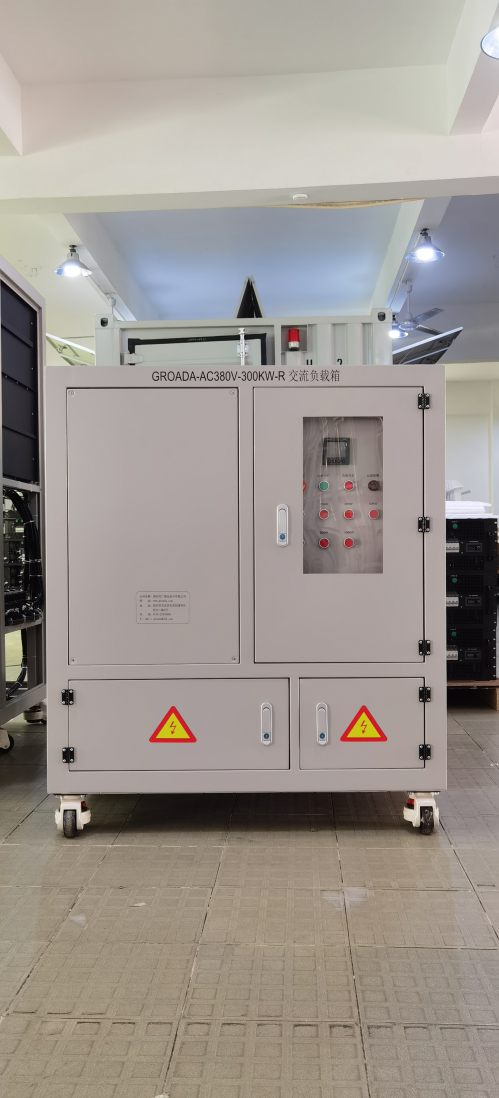
For US shipyard applications, a combined resistive-reactive load bank is usually the smarter investment. Testing a generator only at unity power factor hides how the excitation system and AVR behave under reactive stress, which is exactly the condition marine loads create. If your budget forces a choice, prioritize a resistive unit sized to your largest generator, then add reactive capacity as projects justify it.
Match Ratings to Your Power Systems
Marine generators and shore power connections vary widely, so confirm voltage, frequency, and capacity before you buy. US shipyards commonly work with 480V and 600V systems at 60Hz, but naval and international vessels may require 690V or 50Hz capability. Choose a load bank with a voltage range that covers your fleet and a kW rating that reaches at least 100% of your largest generator, with headroom for future growth. Undersizing forces you to parallel multiple units, which adds complexity and setup time on a busy dock.
Pay attention to load step resolution. Fine control steps, such as increments of a few kW, let you follow precise test profiles and catch instability that coarse steps miss. For commissioning documentation and warranty compliance, this granularity often matters as much as raw capacity.
Prioritize Corrosion Protection and Enclosure Rating
This is where marine-grade equipment earns its name. Salt-laden air corrodes ordinary steel and degrades electrical connections quickly. Look for enclosures rated NEMA 4 or NEMA 4X, with 4X offering superior corrosion resistance through stainless steel or heavy-duty powder-coated construction. Marine-grade aluminum and stainless hardware, sealed gaskets, and corrosion-resistant terminal blocks all extend service life in a coastal shipyard.
Inspect internal components too. Stainless steel resistive elements, conformal-coated control boards, and sealed contactors resist the humidity that destroys standard parts. A unit that looks rugged on the outside but uses commodity internals will still fail early in a marine setting.
Verify Cooling and Ventilation Design
Load banks generate significant heat, and cooling design affects both reliability and where you can safely operate the unit. Most marine-grade load banks use forced-air cooling with high-flow fans. Confirm that intake and exhaust are positioned to avoid recirculating hot air, and that filters are accessible for the frequent cleaning a dusty, salty yard demands. For confined dockside spaces, ducted exhaust options help direct heat away from personnel and sensitive equipment.
Thermal protection is non-negotiable. The unit should include over-temperature shutdown, airflow sensors, and fan-failure detection that safely removes load before damage occurs. These safeguards protect both the load bank and the generator under test.
Confirm Certifications and Compliance
US shipyard projects, especially those involving government or naval contracts, carry strict compliance requirements. Look for UL listing or UL recognition for the electrical build, and ask whether the unit meets relevant ABS, USCG, or MIL-STD requirements when the project calls for them. Documentation matters: a supplier who provides calibration certificates, test reports, and traceable component data makes your own commissioning paperwork far easier to complete.
If your project falls under Buy American Act or similar procurement rules, verify country of origin and domestic content early. Discovering a compliance gap after delivery can stall an entire commissioning schedule.
Weigh Portability and Deployment
Shipyards are large, and test locations change daily. Portable and trailer-mounted load banks with forklift pockets, lifting eyes, and rugged casters move easily between berths and drydocks. Consider connection style as well: quick-connect cam-lock terminals speed setup and reduce error compared with bare-lug connections. For permanent test bays, a stationary unit with hardwired connections may serve better, so match the form factor to how your team actually works.
Evaluate Controls, Data Logging, and Support
Modern load banks offer digital controls with programmable test sequences, remote operation, and automated data logging. For commissioning, the ability to record kW, voltage, current, frequency, and power factor throughout a timed test creates the audit trail customers and classification societies expect. Remote control also keeps operators at a safe distance during high-power testing.
Finally, weigh supplier support. Marine-grade load banks are long-term assets, so ask about spare parts availability, calibration services, warranty terms, and lead times for repairs. A responsive US-based service network prevents a single fault from idling a test program for weeks.
Frequently Asked Questions
1. What enclosure rating should a marine-grade load bank have? For coastal shipyard use, choose NEMA 4X for the best corrosion resistance, or NEMA 4 as a minimum. The 4X rating typically uses stainless steel or heavy corrosion-resistant coatings that stand up to salt spray and washdown conditions.
2. Do I need a resistive or resistive-reactive load bank for generator testing? A resistive load bank tests real power output and prevents wet-stacking. A resistive-reactive unit adds inductive loading to test the alternator and voltage regulator at realistic marine power factors, usually 0.8 lagging. For complete commissioning, resistive-reactive is preferred.
3. How do I size a load bank for my project? Match the kW rating to at least 100% of your largest generator, and confirm voltage and frequency compatibility, commonly 480V or 600V at 60Hz in US yards. Add headroom for future capacity so you avoid paralleling multiple units.
4. What certifications matter for US shipyard procurement? Look for UL listing or recognition, plus ABS, USCG, or MIL-STD compliance when the contract requires them. For government work, verify Buy American Act content and request calibration certificates and test documentation.
5. Can load banks be moved around a shipyard easily? Yes. Portable and trailer-mounted units with forklift pockets, lifting eyes, and cam-lock connectors are designed for frequent relocation between berths and drydocks, while stationary units suit dedicated test bays.