Our Top 4 High Stability Load Banks for Precision Power Calibration
Precision power calibration lives or dies on the stability of the load applied during testing. When you calibrate a generator, a UPS, an inverter, or a battery system, the reference load must hold its value while your instruments read voltage, current, power factor, and frequency. A drifting load introduces measurement uncertainty that no amount of downstream math can fully correct. That is why engineers who take calibration seriously invest in high stability load banks rather than improvised resistive arrays.
This guide walks through the four load bank designs we recommend most often for precision power calibration work. Each one earns its place through thermal stability, tight resistance tolerance, and repeatable performance across long test cycles. Whether you calibrate in a controlled metrology lab or in the field alongside heavy equipment, one of these configurations will match your accuracy target and your budget.
Why Load Stability Matters in Calibration
A load bank converts electrical energy into heat through resistive, inductive, or capacitive elements. During calibration you rely on the load to present a known, unchanging burden to the source under test. Two effects work against you. First, resistive elements change value as they heat, a phenomenon governed by the temperature coefficient of resistance. Second, airflow, ambient temperature, and element aging all nudge the effective load over time.
For a resistive element with a temperature coefficient of 0.0004 per degree Celsius, a 200 degree rise shifts resistance by roughly 8 percent. If your calibration procedure assumes a fixed 100 kW load and the elements drift, your true load might sit several kilowatts off target before the test even settles. High stability load banks attack this problem with low temperature coefficient alloys, generous element sizing, and closed loop control that trims the load back to setpoint.
The payoff is direct. Tighter load stability means lower measurement uncertainty, which means your calibration certificates carry more weight and your customers trust the numbers. For accredited labs working to ISO/IEC 17025, load stability often becomes a documented contributor in the uncertainty budget, so choosing the right hardware pays off during audits as well as during daily work.
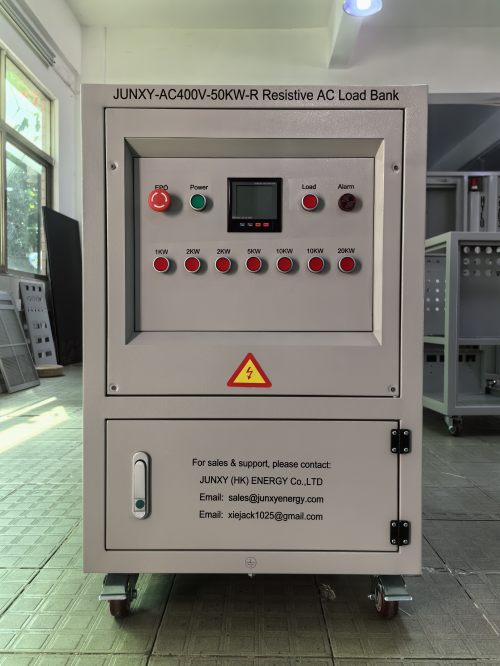
1. Precision Resistive Load Bank with Low TCR Elements
Our first recommendation is the workhorse of precision calibration: a purely resistive load bank built around low temperature coefficient of resistance (TCR) elements. Instead of standard nichrome ribbon, these units use precision alloys with a TCR an order of magnitude lower than commodity heating wire. The result is a load that barely moves as it warms.
Key characteristics that make this design our top choice for lab work:
- Resistance tolerance held within plus or minus 0.5 percent across the rated temperature range.
- Forced air cooling with regulated fan speed to keep element temperature in a narrow band.
- Fine step resolution, often down to a few hundred watts, so you can dial in exact load points.
- Unity power factor, which simplifies power meter verification and removes reactive components from the uncertainty budget.
This configuration shines when you calibrate power analyzers, watt meters, and current transformers where a clean, stable real power draw is exactly what the procedure calls for. Because the load is purely resistive, the current and voltage stay in phase and your reference calculations stay simple.
2. Water Cooled Load Bank for Extended High Power Runs
Air cooled banks perform well up to a point, but when you need to hold tens or hundreds of kilowatts stable for hours, thermal management becomes the limiting factor. Water cooled load banks solve this by circulating coolant through or around the resistive elements, extracting heat far more efficiently than air alone.
The stability advantage is significant. A liquid cooling loop with a regulated inlet temperature holds element temperature nearly constant regardless of load duration. That eliminates the slow upward drift you see in air cooled units as the enclosure heats up over a long test. For endurance testing of large generators or continuous calibration of high power sources, this stability over time is decisive.
Practical considerations to plan for:
- You need a coolant supply, whether a closed loop chiller or a facility water connection with adequate flow and pressure.
- Inlet temperature control matters. A stable coolant temperature translates directly into a stable load, so pair the bank with a chiller that regulates to within a couple of degrees.
- The compact footprint compared to an air cooled unit of the same rating is a genuine benefit in space constrained labs.
Water cooled designs suit facilities that run frequent high power calibrations and can justify the supporting coolant infrastructure. The reward is exceptional thermal stability during the long dwell times that high accuracy work demands.
3. Resistive Reactive Load Bank for Power Factor Calibration
Real power is only part of the picture. Many devices, from UPS systems to backup generators, must be characterized across a range of power factors. A resistive reactive load bank combines resistive elements with inductive stages so you can present loads at leading and lagging power factors, not just unity.
For calibration this capability lets you verify that a power meter reads correctly when current and voltage are out of phase. You can set, for example, a 0.8 lagging power factor and confirm the meter reports real power, apparent power, and power factor accurately. Without a reactive load you can only ever check the unity power factor corner of the meter's operating envelope.
Stability in these units comes from careful design of the inductive stages. Well built reactors hold their inductance steady with load and temperature, so the power factor you set is the power factor you get throughout the test. Look for units that switch reactive elements in defined increments and that specify inductance tolerance, not just resistance tolerance.
This design is the right pick when your calibration scope includes reactive power and power factor across the full range, which is increasingly common as more equipment is specified for non unity operation.
4. Programmable Modular Load Bank with Closed Loop Feedback
The fourth recommendation is the most flexible: a programmable modular load bank that reads back actual load and trims itself to setpoint. Rather than relying solely on the physical stability of the elements, these units add a control layer. A controller measures the real load and adjusts switching to compensate for drift, holding the delivered power at target far more tightly than open loop designs.
Why this matters for precision calibration:
- Closed loop feedback corrects for element heating in real time, so the load stays on target even as the resistive elements warm up.
- Programmable profiles let you sequence through multiple load points automatically, which reduces operator handling and improves repeatability.
- Modular construction means you scale capacity by adding sections, and you can mix resistive and reactive modules to match the task.
- Digital communication interfaces let the load bank integrate into an automated calibration bench, logging setpoints and actual values alongside your instrument readings.
The modular approach also protects your investment. As calibration needs grow, you expand the same platform rather than replacing it. For labs building automated, traceable calibration workflows, the combination of feedback control and programmability makes this the most future proof option of the four.
How to Choose Among the Four
Matching the load bank to the job comes down to a few questions. Start with power level and test duration. Short, moderate power calibrations are well served by the precision resistive bank, while long high power runs call for water cooling. Next, consider power factor. If your scope stays at unity, a resistive design is enough; if you must characterize reactive behavior, the resistive reactive unit is essential.
Then weigh automation. If you run high volumes or need traceable, hands off procedures, the programmable modular bank pays for itself in throughput and repeatability. Finally, factor in your facility. Water cooling and modular expansion both carry infrastructure implications that are easier to plan for up front than to retrofit later.
Getting the Most Stability From Any Load Bank
Hardware sets the ceiling, but technique determines how close you get to it. A few practices help every one of these designs perform at its best. Let the bank reach thermal equilibrium before you record calibration data, since the largest drift happens in the first minutes of a test. Keep ambient conditions steady, because airflow and room temperature affect even the most stable elements. And calibrate the load bank itself on a schedule, so the reference you rely on stays trustworthy.
Documenting load stability as part of your uncertainty budget turns a good instrument into a defensible measurement system. When you can show that your load held within a known tolerance during the test, your calibration results stand up to scrutiny.
Precision power calibration rewards the engineer who respects the load as a reference in its own right. Choose the design that fits your power range, power factor needs, and automation goals, treat it with disciplined technique, and your calibration accuracy will follow. Any of these four high stability load banks will give you a dependable foundation for measurements you can defend.









