Our Top 7 Three-phase Load Banks for Industrial Generator Set Testing
Why Three-Phase Load Bank Testing Is Non-Negotiable for Industrial Gensets
An industrial generator set that has never been run at rated load is an unverified asset. Many diesel gensets spend their lives at 20–40 % of nameplate capacity, a regime that promotes wet stacking, unburned fuel carryover, cylinder glazing and carbon fouling. A three-phase load bank applies a controlled, measurable, power-factor-adjustable load so you can prove real capacity, tune voltage and frequency regulation, verify paralleling behaviour and document fuel consumption — all without energizing a live facility.
Three-phase testing matters because real industrial loads are unbalanced, inductive and non-linear. Single-phase resistive-only testing tells you very little about how an alternator behaves when phase voltage drifts, when a 0.8 lagging power factor pushes excitation to its limit, or when harmonics heat the windings.
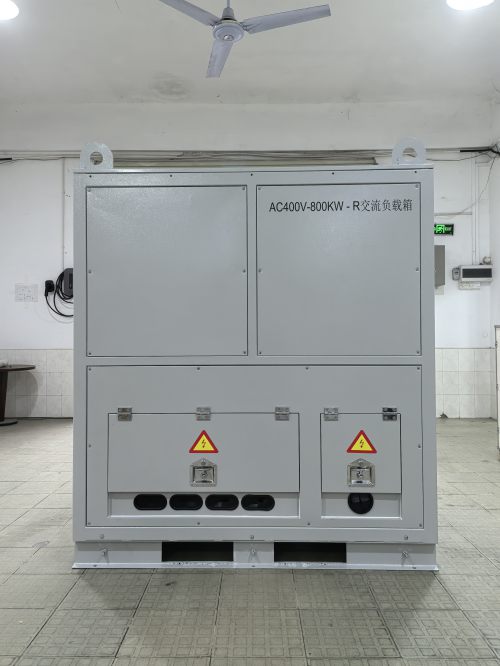
How We Ranked Our Top 7 Three-Phase Load Banks
Every unit below was scored on five engineering criteria: (1) usable capacity and step resolution; (2) voltage range and phase flexibility; (3) ability to reproduce real power factors, not just unity; (4) control and data-capture capability; (5) serviceability — because a load bank that is hard to maintain is a load bank that gets skipped.
1. LB-125R Compact Rack Load Bank — 125 kW at 208–480 V
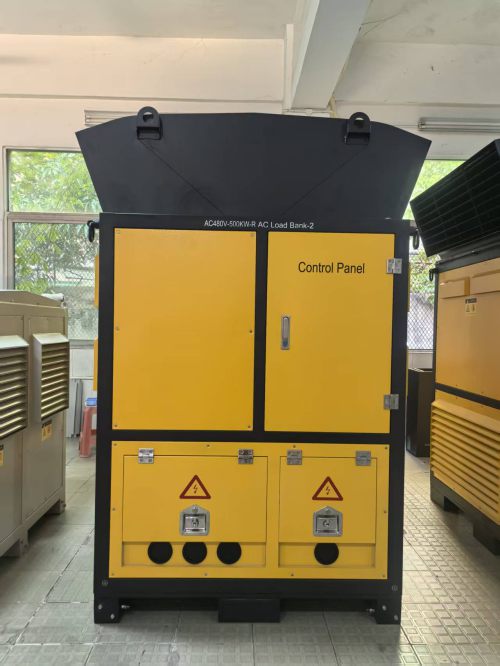
Our smallest three-phase unit and the workhorse of field service engineers. Twelve discrete steps from 5 kW to 125 kW give fine-grained loading, so you can walk a genset through 25 %, 50 %, 75 % and 100 % of nameplate in precise increments. The 480 V / 208 V dual-tap configuration covers most commercial three-phase distribution. Fan-powered forced-air cooling with a low-noise blade set keeps it usable inside a plant room.
Best for: service vans, small standby gensets, preventive-maintenance contracts, and verifying ATS transfer under load.
2. LB-250T Trailer-Mounted Three-Phase Load Bank — 250 kW
A towable, weatherproof (IP54) resistive load bank built for rental fleets and multi-site industrial portfolios. Cable reels, cam-lock terminations and a folding control console let a two-person crew commission a genset in under an hour. Load steps are selectable in 5 kW elements, and the integrated digital meter pack logs voltage, current per phase, kW, kVA, frequency and power factor at one-second intervals.
Best for: data centres, hospitals, and manufacturing plants that periodically load-test standby units without permanently installed load banks.
3. LB-500RR Resistive-Reactive Load Bank — 500 kW at 0.8 PF
The first unit in this list that steps beyond unity power factor. Resistive elements handle real power while switched reactor banks add lagging reactive load, letting you hold 0.8 PF across the full range. This is the configuration that exposes excitation-system weakness, AVR instability and alternator thermal limits that unity-PF testing hides entirely.
Best for: acceptance testing of new gensets, generator OEM factory tests, and troubleshooting voltage-regulator faults.
4. LB-1000C Containerized Load Bank — 1 MW, 380–690 V
Built into a standard 10-foot ISO container with louvred air discharge, this unit delivers 1 MW of three-phase load with a 1 kW minimum step and integrated resistive/reactive sections. Remote control via Ethernet, Modbus TCP or a handheld pendant; load profile scripting lets you run a 24-hour endurance cycle unattended with automatic step changes and alarm logging.
Best for: utility-scale standby plants, refinery and mining sites, and any facility needing documented N+1 proof of capacity.
5. LB-1500MV Medium-Voltage Load Bank — 1.5 MW at 4.16 kV
Medium-voltage testing is where most field teams lack equipment. This unit accepts 2.4 kV to 4.16 kV three-phase directly through a dedicated MV enclosure, eliminating the cost and loss of a step-down transformer. Vacuum contactors, integral CTs and full arc-flash-rated barriers keep the operator outside the restricted approach boundary.
Best for: MV generator acceptance tests, co-generation plants, and large chiller or compressor stations.
6. LB-2500M Modular Parallel Load Bank — 2.5 MW Expandable
A modular architecture: each 500 kW skid is self-contained, and up to five skids parallel onto a common bus for 2.5 MW. Steps as small as 1 kW remain available at full capacity because the master controller sequences elements across all skids. Ideal where the test requirement grows faster than the capital budget — buy one skid, add capacity later.
Best for: multi-megawatt data-centre campuses, shipyards, and test cells that serve several genset sizes.
7. LB-5000U Universal Automated Test System — 5 MW with RLC Capability
Our flagship: resistive, inductive and capacitive sections under one controller, covering 0.3 lagging through 0.8 leading power factor. Capacitive capability lets you test the leading-PF case that matters for UPS-backed systems and for gensets feeding long cable runs. Automated test sequences execute IEEE 3006.4-style load profiles, generate pass/fail reports and export to your CMMS.
Best for: OEM end-of-line testing, independent test laboratories, and turnkey commissioning contracts.
Side-by-Side Comparison
| Model | Capacity | Voltage | Power Factor Range | Mobility | Typical Application |
|---|---|---|---|---|---|
| LB-125R | 125 kW | 208–480 V | 1.0 | Rack / portable | Service and PM visits |
| LB-250T | 250 kW | 208–600 V | 1.0 | Trailer | Rental fleet testing |
| LB-500RR | 500 kW | 380–600 V | 0.8 lag – 1.0 | Skid | Acceptance testing |
| LB-1000C | 1 MW | 380–690 V | 0.8 lag – 1.0 | Container | Industrial standby plants |
| LB-1500MV | 1.5 MW | 2.4–4.16 kV | 0.8 lag – 1.0 | Skid | Medium-voltage gensets |
| LB-2500M | 2.5 MW | 380–690 V | 0.8 lag – 1.0 | Modular skids | Data-centre campuses |
| LB-5000U | 5 MW | 380–690 V | 0.3 lag – 0.8 lead | Fixed / cell | OEM and lab testing |
A Practical Three-Phase Load Test Sequence
- Pre-test inspection. Confirm cable ampacity, torque terminations, and record ambient temperature — capacity corrections depend on it.
- No-load start. Verify rated voltage, frequency and phase rotation before any load is applied.
- Step loading. Apply 25 %, 50 %, 75 % and 100 % in increments, holding each step at least 10 minutes to allow coolant and winding temperatures to stabilize.
- Power-factor sweep. Test at 1.0, 0.8 lagging and — where capability exists — 0.8 leading.
- Transient test. Block-load the genset from no load to 100 % in a single step and capture the voltage dip and recovery time.
- Soak and record. Hold rated load for the full specified duration (commonly 4–8 hours) while logging exhaust temperature, fuel rate and kW/kVA/PF.
- Controlled unload and cool-down. Step down gradually; never cut a hot element bank instantly.
Selection Guidance: Matching Load Bank to Genset
Size the bank at 100–125 % of the genset's prime rating. Under-sizing makes it impossible to prove capacity; over-sizing wastes capital and forces long cable runs. Match voltage class exactly where possible — a transformer between load bank and genset introduces reactance that distorts the power-factor measurement. If your test schedule rotates between several sites, mobility outweighs capacity. If you test one machine repeatedly, automation and data logging pay back within a few test cycles.
Frequently Asked Questions
Can I test a three-phase genset with a single-phase load bank? Only for limited purposes. It cannot verify regulation under balanced three-phase load or reproduce realistic phase imbalance, and many alternators will not accept full single-phase output.
Why is 0.8 power factor important? A genset rated 0.8 PF reaches its excitation and thermal limits at that point. Unity-PF testing never loads the exciter fully, so genuine capacity remains unproven.
How often should load bank testing be performed? Annually as a minimum; quarterly for life-safety and mission-critical installations, and always after major fuel-system or alternator work.
Does load bank testing damage the genset? No. It removes the damage that light loading causes — wet stacking, carbon build-up and unburned fuel in the exhaust.
Final Thoughts
Choosing a three-phase load bank is a decision about evidence: how convincingly you can demonstrate that a generator will carry its load when the utility feed disappears. From the 125 kW rack unit that lives in a service van to the 5 MW automated system in an OEM test cell, each of these seven designs solves a specific verification problem. Match the bank to your voltage class, your required power factor and your test cadence — then run the test, record the numbers, and keep them. That documentation is what turns a standby genset from an assumption into a proven asset.