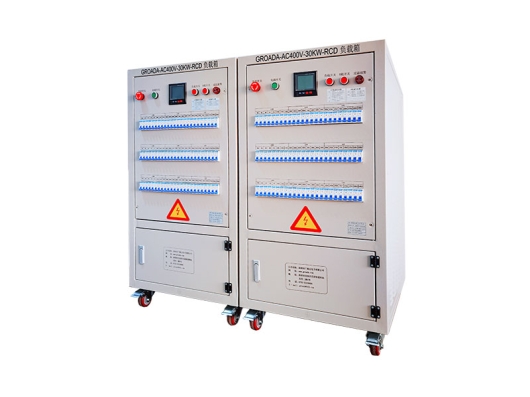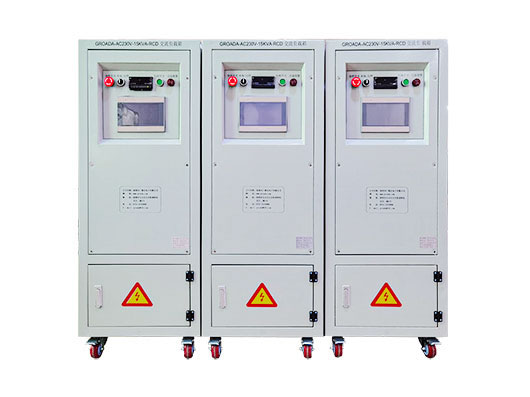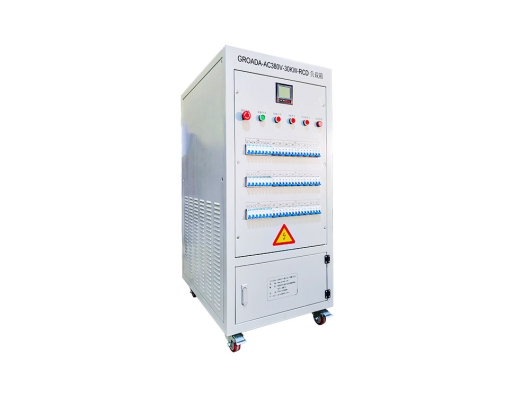
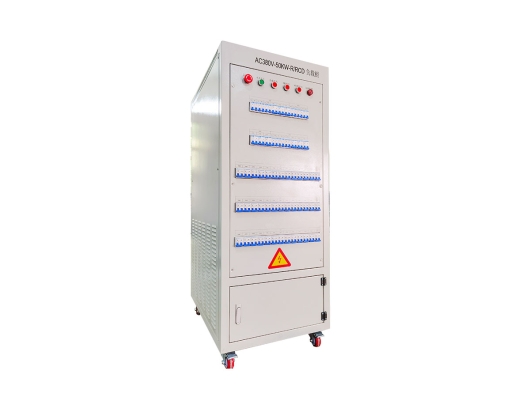
Product images are provided for visual reference. Please confirm the final configuration and specifications with our team.
Industrial Testing Equipment
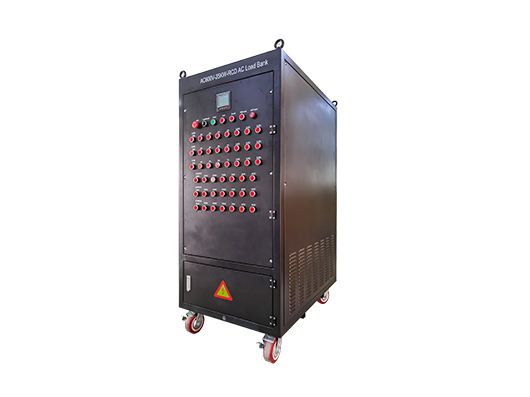
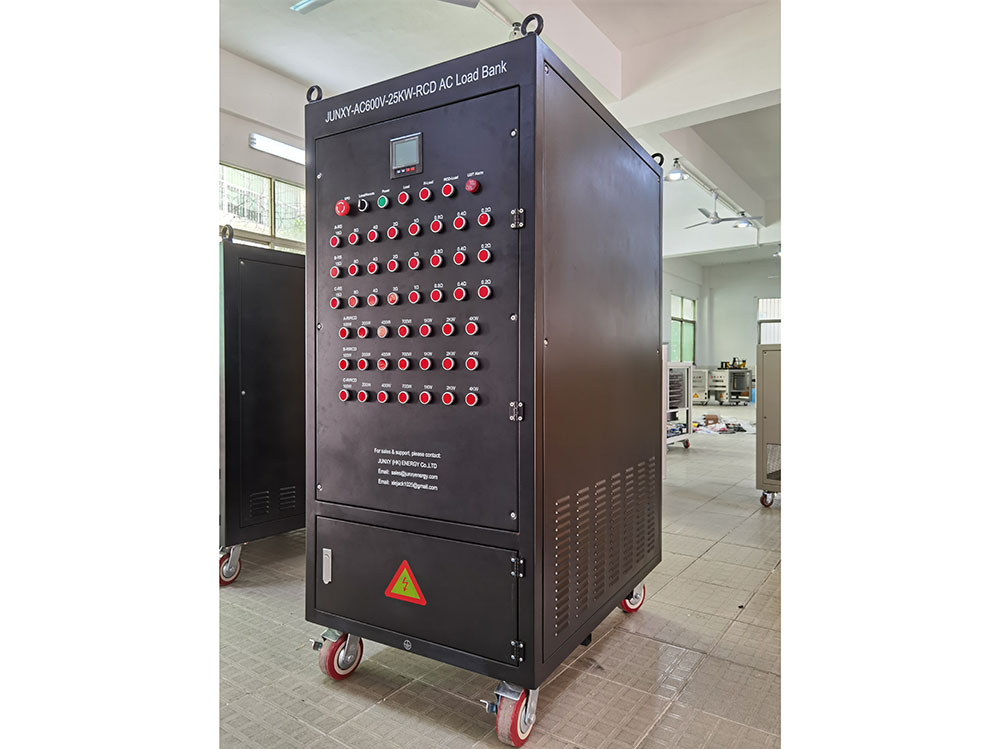
GROADA-AC600V-25KW-RCD inverter load bank
Explore product details and technical information, or send us your requirements for application guidance and a quotation.
Request Product Information
Tell us what you need. Our team can follow up with product details and quotation information.
Product Overview & Technical Specifications
| Model | AC220V-5KW-RCD | AC220V-10KW-RCD | AC220V-15KW-RCD | AC220V-20KW-RCD | AC380V-30KW-RCD | AC380V-50KW-RCD | AC380V-60KW-RCD | AC380V-100KW-RCD | AC380V-200KW-RCD |
| Rated power | R=5KW | R=10KW | R=15KW | R=20KW | R=30KW | R=50KW | R=60KW | R=100KW | R=200KW |
| RCD=5KVA | RCD=10KVA | RCD=15KVA | RCD=20KVA | RCD=30KVA | RCD=50KVA | RCD=60KVA | RCD=100KVA | RCD=200KVA | |
| Input current | 0-22A | 0-45A | 0-45A | 0-90A | 0-45A | 0-300A | 0-450A | 0-600A | 0-750A |
| Size (width * depth * height mm) | 500*600*800 | 500*600*1000 | 500*600*1100 | 500*750*1100 | 600*850*1400 | 600*850*1600 | 600*850*1850 | 700*1000*1800 | 1100*1400*1800 |
| Weight | 50KG | 80KG | 100KG | 130KG | 200KG | 300KG | 350KG | 450KG | 550KG |
| Input voltage | AC220/230V | AC380/400V | |||||||
| Other input voltage can be customized according to requirements | |||||||||
| Minimum loading | 100W | 100W | 100W | 100W | 100W | 1KW | 1KW | 1KW | 1KW |
| Other minimum loading power can be customized according to requirements | |||||||||
| Overall accuracy | 3% (other accuracy requirements can be customized according to requirements) | ||||||||
| power factor | PF=0.6~1.0 | ||||||||
| peak coefficient | 2 to 3 | ||||||||
| Control mode | Local manual/remote host computer (local manual control mode: circuit breaker/button/touch screen three-way optional, other methods can be customized as required) | ||||||||
| Remote Interface | RS232/RS485/USB/RJ45/CAN/GPIB (other interface modes can be customized according to requirements) | ||||||||
| Protection function | Emergency stop protection, over-temperature protection, fan load interlock protection, grounding protection (select over-voltage protection, over-current protection, short-circuit protection, fan overload, insufficient air volume) | ||||||||
| Working power supply | AC220V | AC220V/AC380V | |||||||
| Display accuracy | 0.5 level (other explicit precision can be customized according to requirements) | ||||||||
| Display parameters | Voltage, current, power, frequency, power factor, etc. (other explicit methods can be customized according to requirements) | ||||||||
| Cold sure way | Side air inlet and upper air outlet (other air outlet methods can be customized according to requirements) | ||||||||
| Protection level | IP20 (other protection level can be customized according to requirements) | ||||||||
| Appearance color | RAL7035 (other colors can be customized according to requirements) | ||||||||
| Working temperature | -10 ℃ ~ 55 ℃ | ||||||||
| Relative humidity | ≤95%RH | ||||||||
| Altitude | ≤ 2500 m | ||||||||
GROADA AC600V 25 kW Inverter Load Bank
High-Precision Testing for Inverter Reliability
The GROADA AC600V 25 kW Inverter Load Bank is a purpose-built testing solution for inverter manufacturers, laboratories, and power electronics engineers who require accurate, repeatable, and safe performance validation. Designed for modern renewable energy and energy storage applications, it provides a controlled environment to simulate real-world operating conditions and ensure that inverters meet stringent reliability and efficiency standards.
As solar, battery, and microgrid systems continue to expand, inverter reliability has become more critical than ever. A professional load bank is essential to verify design claims, reduce risk of failure, and build customer trust.
What Is an Inverter Load Bank?
An inverter load bank is a precision device that applies an electrical load to an inverter under test in a safe, controlled manner. Unlike passive field testing, which exposes equipment to unpredictable conditions, a load bank delivers stable and adjustable loads, enabling engineers to:
-
Measure conversion efficiency across different load levels
-
Analyze inverter thermal behavior under continuous operation
-
Validate overcurrent, overvoltage, and protection features
-
Test inverter performance with both resistive and reactive loads
-
Confirm grid-compliance functions such as anti-islanding and synchronization
This makes the GROADA AC600V 25 kW Load Bank an indispensable tool for inverter R&D, production quality assurance, and third-party certification.
Key Features of the GROADA AC600V 25 kW Load Bank
-
600 V DC input and 25 kW power capacity — suitable for medium-scale PV and ESS inverters
-
Programmable load profiles — supports stepped, gradual, or dynamic load changes
-
Resistive, reactive, and inductive test modes — replicates real-world load conditions
-
Energy regenerative design — reduces wasted energy by feeding it back to the grid
-
High measurement accuracy — captures voltage, current, frequency, THD, and power factor with precision
-
Comprehensive protection — includes overcurrent, overvoltage, and thermal safeguards
-
Modular scalability — units can be combined for higher test power requirements
-
Industrial-grade reliability — robust cooling, durable construction, and long service life
Why Load Bank Testing Matters
Efficiency Testing
By gradually stepping through load levels (10%, 20%, 50%, 100%), engineers can generate inverter efficiency curves and quantify power losses. This is essential for meeting regulatory requirements and optimizing design.
Durability & Thermal Stress
Sustained full-power operation simulates demanding field conditions. Engineers can verify cooling system performance, detect hot spots, and assess component aging over time.
Reactive & Inductive Loads
Real electrical networks rarely operate with pure resistive loads. The ability to test with inductive or capacitive elements ensures accurate validation of power factor correction, stability, and reactive power handling.
Dynamic Response & Transients
Step loads, sudden drops, or rapid fluctuations test the robustness of inverter control loops. Load banks can uncover hidden weaknesses in firmware or protection systems that would otherwise appear only in the field.
Grid Compliance
Grid codes worldwide require inverters to handle abnormal conditions such as voltage dips, frequency shifts, or anti-islanding detection. A load bank allows safe simulation of these events to prove compliance with IEC, IEEE, and UL standards.
Applications Across Industries
-
Solar Photovoltaic Inverters — verifying efficiency, MPP tracking, and safety under variable sunlight conditions
-
Energy Storage Systems (ESS) — testing bidirectional inverters and charge/discharge cycles
-
Microgrids and Hybrid Power Systems — ensuring reliable power sharing and seamless transitions
-
R&D Laboratories — supporting prototype evaluation and academic research in power electronics
-
Manufacturing QA — providing repeatable end-of-line testing before product shipment
Benefits of the GROADA Solution
-
Trusted Accuracy – Designed with precision instrumentation for reliable test results.
-
Energy Savings – Regenerative design minimizes waste and reduces operational costs.
-
Operator Safety – Integrated protections and emergency shutoffs ensure safe operation.
-
Flexibility – Adaptable to multiple inverter types, from residential PV to industrial storage.
-
Future-Proof – Modular capacity supports expansion as test demands grow.
Industry Standards and Compliance
The GROADA 25 kW Inverter Load Bank is engineered to support compliance testing with major global standards, including:
-
IEC 62116 – Test procedure of islanding prevention measures for grid-connected PV inverters
-
IEC 61000 – Electromagnetic compatibility requirements
-
IEEE 1547 – Standard for interconnection and interoperability of distributed resources
-
UL 1741 – Inverters, converters, and controllers for use in distributed energy resources
Meeting these standards is essential for manufacturers aiming to enter international markets with certified products.
Why Choose GROADA?
GROADA specializes in advanced load bank solutions for the renewable energy and power electronics industries. Our engineering team brings years of field experience and technical expertise, ensuring products that combine innovation, durability, and cost efficiency.
By partnering with GROADA, customers gain more than equipment — they gain a trusted testing partner committed to quality, reliability, and global support.
Conclusion
The GROADA AC600V 25 kW Inverter Load Bank empowers inverter developers, manufacturers, and testing laboratories with a reliable, precise, and efficient tool for performance validation. From efficiency mapping to grid-compliance testing, it delivers the insights needed to design robust, safe, and market-ready inverters.
Investing in a professional load bank is not just about compliance — it is about ensuring long-term reliability, customer satisfaction, and competitive advantage in the fast-growing renewable energy sector.