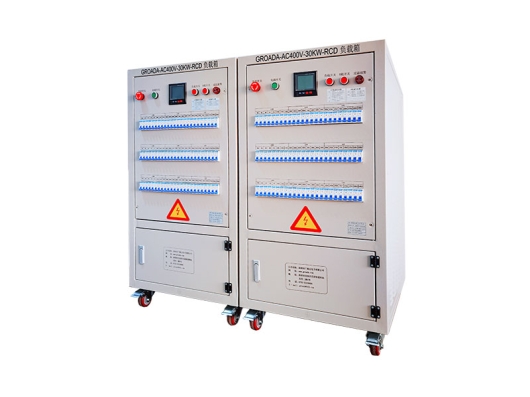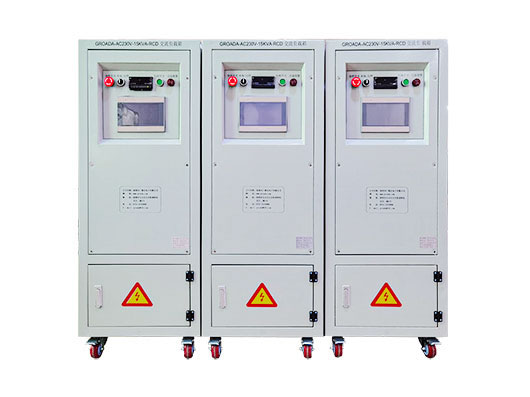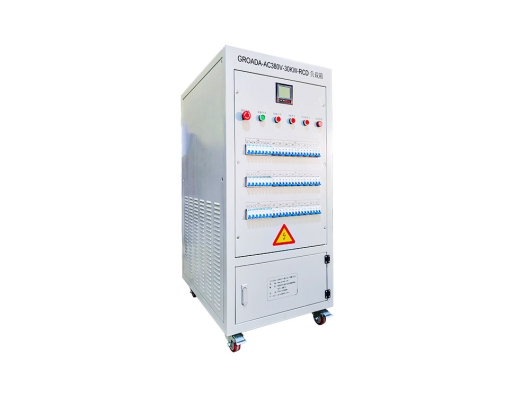
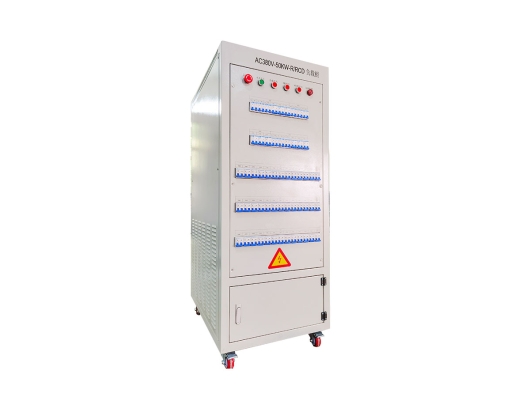
Product images are provided for visual reference. Please confirm the final configuration and specifications with our team.
Industrial Testing Equipment
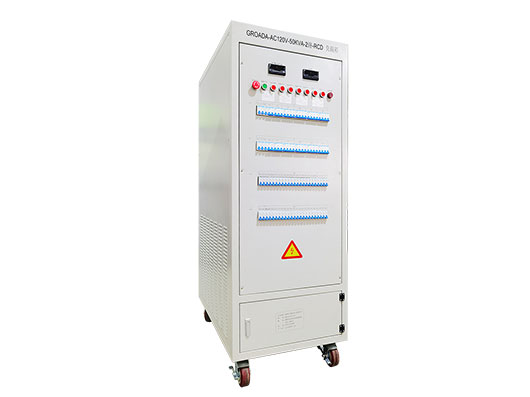
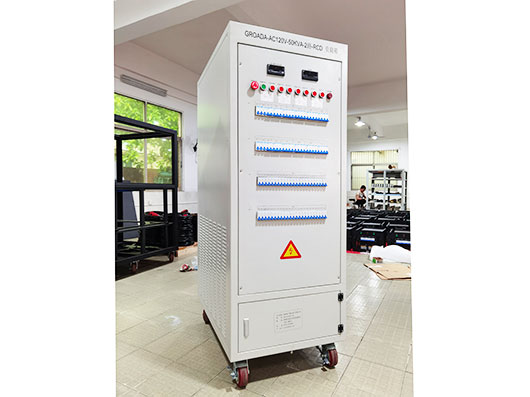
GROADA-AC120V-50KVA-RCD inverter load bank
Explore product details and technical information, or send us your requirements for application guidance and a quotation.
Request Product Information
Tell us what you need. Our team can follow up with product details and quotation information.
Product Overview & Technical Specifications
| Model | AC220V-5KW-RCD | AC220V-10KW-RCD | AC220V-15KW-RCD | AC220V-20KW-RCD | AC380V-30KW-RCD | AC380V-50KW-RCD | AC380V-60KW-RCD | AC380V-100KW-RCD | AC380V-200KW-RCD |
| Rated power | R=5KW | R=10KW | R=15KW | R=20KW | R=30KW | R=50KW | R=60KW | R=100KW | R=200KW |
| RCD=5KVA | RCD=10KVA | RCD=15KVA | RCD=20KVA | RCD=30KVA | RCD=50KVA | RCD=60KVA | RCD=100KVA | RCD=200KVA | |
| Input current | 0-22A | 0-45A | 0-45A | 0-90A | 0-45A | 0-300A | 0-450A | 0-600A | 0-750A |
| Size (width * depth * height mm) | 500*600*800 | 500*600*1000 | 500*600*1100 | 500*750*1100 | 600*850*1400 | 600*850*1600 | 600*850*1850 | 700*1000*1800 | 1100*1400*1800 |
| Weight | 50KG | 80KG | 100KG | 130KG | 200KG | 300KG | 350KG | 450KG | 550KG |
| Input voltage | AC220/230V | AC380/400V | |||||||
| Other input voltage can be customized according to requirements | |||||||||
| Minimum loading | 100W | 100W | 100W | 100W | 100W | 1KW | 1KW | 1KW | 1KW |
| Other minimum loading power can be customized according to requirements | |||||||||
| Overall accuracy | 3% (other accuracy requirements can be customized according to requirements) | ||||||||
| power factor | PF=0.6~1.0 | ||||||||
| peak coefficient | 2 to 3 | ||||||||
| Control mode | Local manual/remote host computer (local manual control mode: circuit breaker/button/touch screen three-way optional, other methods can be customized as required) | ||||||||
| Remote Interface | RS232/RS485/USB/RJ45/CAN/GPIB (other interface modes can be customized according to requirements) | ||||||||
| Protection function | Emergency stop protection, over-temperature protection, fan load interlock protection, grounding protection (select over-voltage protection, over-current protection, short-circuit protection, fan overload, insufficient air volume) | ||||||||
| Working power supply | AC220V | AC220V/AC380V | |||||||
| Display accuracy | 0.5 level (other explicit precision can be customized according to requirements) | ||||||||
| Display parameters | Voltage, current, power, frequency, power factor, etc. (other explicit methods can be customized according to requirements) | ||||||||
| Cold sure way | Side air inlet and upper air outlet (other air outlet methods can be customized according to requirements) | ||||||||
| Protection level | IP20 (other protection level can be customized according to requirements) | ||||||||
| Appearance color | RAL7035 (other colors can be customized according to requirements) | ||||||||
| Working temperature | -10 ℃ ~ 55 ℃ | ||||||||
| Relative humidity | ≤95%RH | ||||||||
| Altitude | ≤ 2500 m | ||||||||
GROADA AC120V 50 kVA RCD Inverter Load Bank — Reliable Load Testing for Large Inverters
Introduction / Short Summary (Second paragraph)
GROADA’s AC120V 50 kVA RCD Inverter Load Bank is purpose-built for high-power inverter load testing and verification. It enables manufacturers, system integrators, and test laboratories to execute full-load, part-load, transient, and ride-through tests reliably and safely. This load bank helps validate inverter performance under real-world conditions, ensuring stable output, compliance, and long-term reliability.
Key Features & Capabilities
-
High Power Handling
This load bank supports continuous and dynamic loads up to 50 kVA at AC120V, making it suitable for medium to large inverters or inverter arrays. -
RCD Protection Integration
It includes RCD (Residual Current Device) safety features to protect against leakage or ground faults during testing. -
Adjustable Load Levels
Users can define incremental stepped or continuously variable loads, enabling simulation of light, medium, and full operating conditions. -
Fast Response & Load Transitions
It can simulate fast load changes or step loads, which is essential to validate inverter transient response, recovery, and ride-through performance. -
Precision Monitoring & Measurement
Integrated measurement modules capture voltage, current, power factor, efficiency, THD, flicker, and waveform distortion in real time. -
Thermal Management & Protection
Equipped with temperature sensors, over-temperature protection, and cooling infrastructure to ensure stable operation over long-duration tests. -
Modular & Expandable Design
The unit can be extended or modularized for higher power ratings or parallel operation, allowing flexible scaling. -
Standards Compliance
Designed to meet safety and measurement standards (e.g. IEC, UL, etc.), ensuring the test environment is credible and trustworthy.
Why Use an Inverter Load Bank?
Ensuring Performance & Reliability
Even certified inverters may fail under real or stress conditions: in one industry test program, one-third of PV inverters failed key performance or safety tests despite having IEC/UL certification.
Using a load bank helps you uncover issues—such as thermal instability, waveform distortion, overcurrent trips, or inability to ride through transients—before field deployment.
Compliance & Certification Support
To meet grid-codes or certification requirements (e.g. IEEE 1547.1 for distributed energy resources), inverter systems must pass a variety of stress and dynamic tests.
A robust load bank is essential to simulate worst-case grid or load conditions.
Accelerated Validation & QA
In production or R&D, load banks facilitate fast, repeatable testing cycles. This is especially valuable in automotive, PV, ESS (energy storage systems), or industrial applications where inverter reliability is critical.
Market Growth & Demand
-
The global end-of-line inverter testing market was valued at about USD 1.27 billion in 2024 and is expected to reach USD 2.85 billion by 2033, a strong CAGR of ≈ 9.4 %.
-
The PV inverter testing system market alone was valued at around USD 220 million in 2024 and is projected to grow to ~USD 450 million by 2033.
-
The overall inverter market (across sectors) is huge — valued at over USD 22 billion in 2024 and forecast to exceed USD 70+ billion by 2032, driven by renewables, electrification, and energy storage expansion.
These trends underscore that high-quality test infrastructure (like load banks) is increasingly indispensable.
Typical Test Applications & Use Cases
-
Full-Load Endurance Tests
Run the inverter at rated output for prolonged periods to verify thermal stability, component degradation, and long-term reliability. -
Partial-Load & Efficiency Mapping
Apply loads at, say, 25%, 50%, 75%, and 100% to map efficiency curves, power factor, and losses across operating range. -
Transient & Step-Load Tests
Introduce sudden load changes (e.g. 10% → 80% → 30%) and monitor how the inverter handles transient events, recovery time, and waveform stability. -
Ride-Through / Fault Simulation
Simulate grid disturbances, faults, or momentary interruptions and evaluate how the inverter maintains output or recovers — critical for compliance and stability. -
Harmonic / Distortion Testing
Introduce non-pure loads or harmonic injection and assess how the inverter performs under nonlinear or distorted loads. -
Multi-Unit / Parallel System Testing
For systems with multiple parallel inverter modules, test how they share load, respond to imbalance, or handle switching dynamics.
Technical Considerations & Best Practices
-
Load Type & Modeling
Use a mix of resistive, inductive, and capacitive loads to emulate real-world conditions. Many inverter tests require reactive power handling and realistic load emulation. -
Instrumentation Accuracy
Ensure measurement modules are precise (e.g. ±0.1% class or better), especially for efficiency and power factor comparisons. -
Thermal Derating
At high power, ambient temperature and internal heating can reduce effective load capacity — plan for margin or active cooling. -
Transient Speed & Control Loop Interaction
The load bank must respond quickly and smoothly to test pulses so the inverter’s control system isn’t tricked by overly slow transitions. -
Isolation & Safety
Proper galvanic isolation, overcurrent protection, and residual current detection (RCD) must be in place to safeguard test hardware and personnel. -
Data Logging & Analysis
Capture high-resolution data (sampling ≥ 1 kHz or more) and provide software tools to analyze instability, harmonics, voltage dips, or anomalies.
Why Choose the GROADA 50 kVA RCD Load Bank?
-
Tailored for High-Power Inverters: Many load banks top out at a few tens of kW; 50 kVA at AC120V positions this unit well above standard commodity test rigs.
-
Safety-Centric Design: Built-in RCD protection helps mitigate faults and enhances confidence in testing environments.
-
Scalability & Flexibility: Its modular architecture allows future upgrades or parallel operation for larger systems.
-
Precision & Responsiveness: Designed for fast load steps and stable control, ideal for dynamic performance tests.
-
Proven Technology & Support: Backed by GROADA’s expertise and experience in power electronics testing.