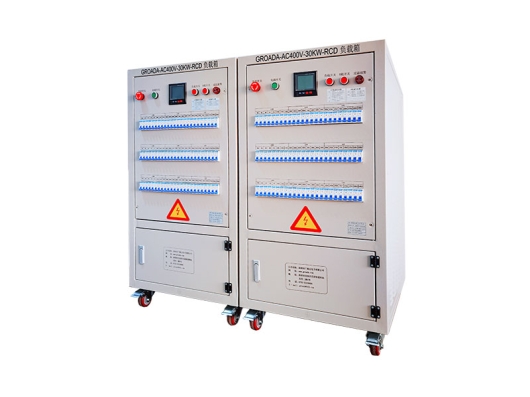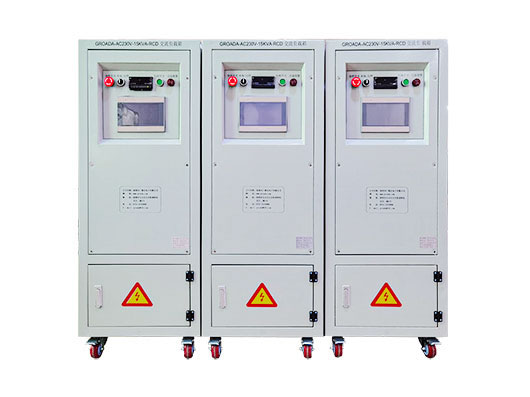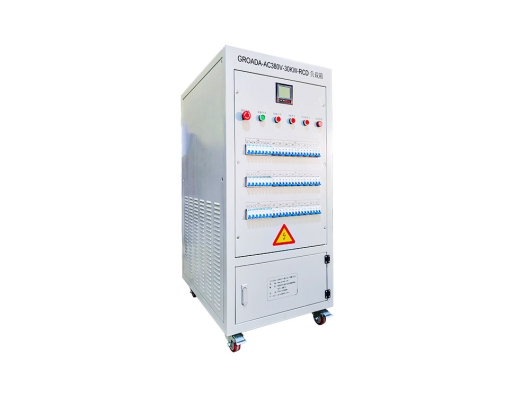
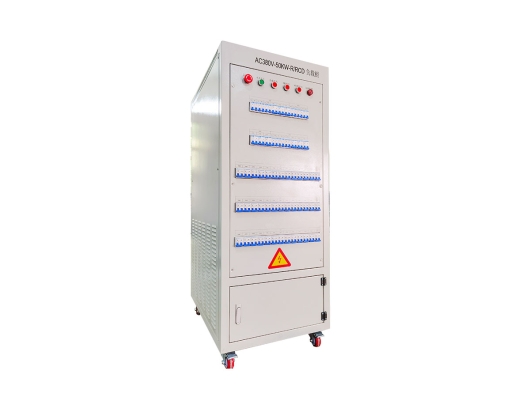
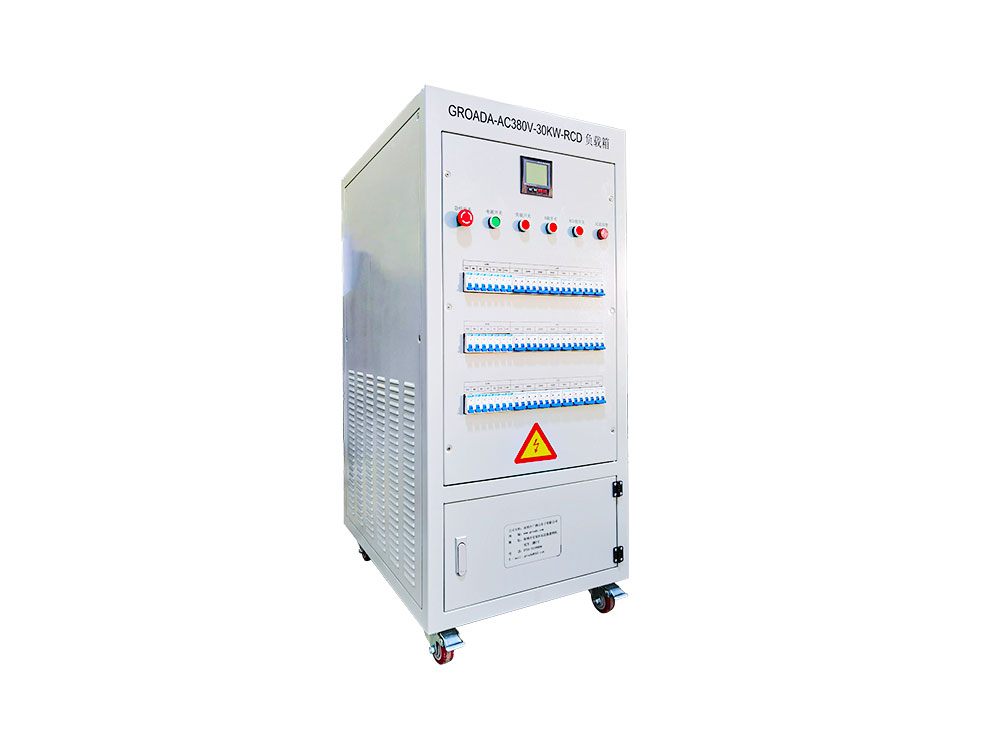
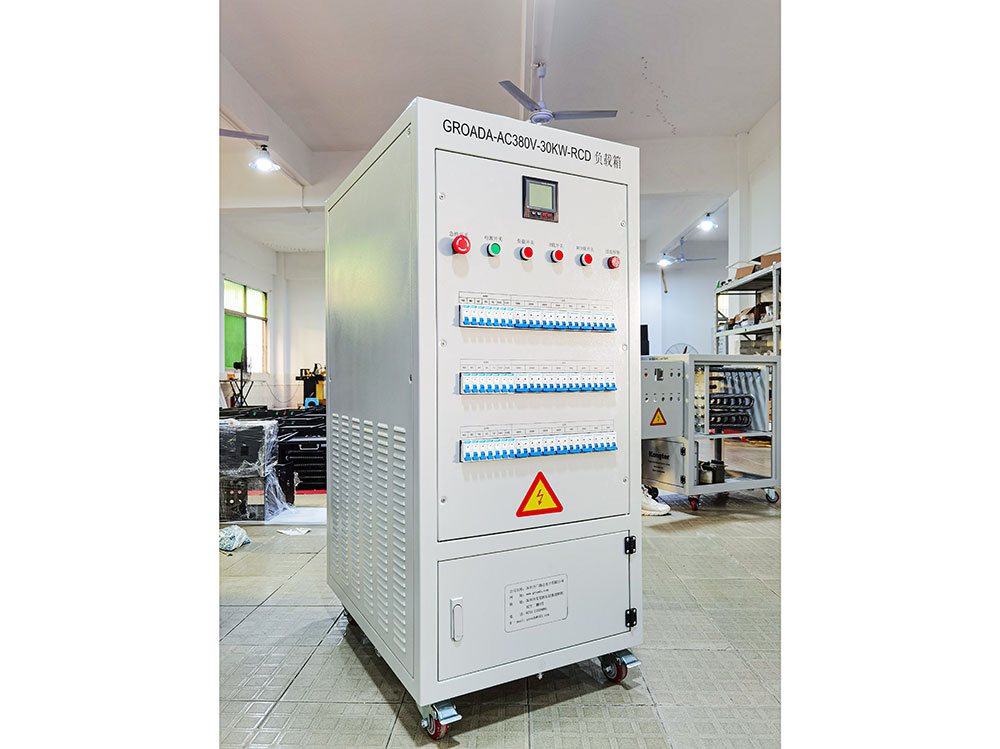
Product images are provided for visual reference. Please confirm the final configuration and specifications with our team.
Industrial Testing Equipment
GROADA-AC380V-30KW-RCD inverter load bank
Explore product details and technical information, or send us your requirements for application guidance and a quotation.
Request Product Information
Tell us what you need. Our team can follow up with product details and quotation information.
Product Overview & Technical Specifications
| Model | AC220V-5KW-RCD | AC220V-10KW-RCD | AC220V-15KW-RCD | AC220V-20KW-RCD | AC380V-30KW-RCD | AC380V-50KW-RCD | AC380V-60KW-RCD | AC380V-100KW-RCD | AC380V-200KW-RCD |
| Rated power | R=5KW | R=10KW | R=15KW | R=20KW | R=30KW | R=50KW | R=60KW | R=100KW | R=200KW |
| RCD=5KVA | RCD=10KVA | RCD=15KVA | RCD=20KVA | RCD=30KVA | RCD=50KVA | RCD=60KVA | RCD=100KVA | RCD=200KVA | |
| Input current | 0-22A | 0-45A | 0-45A | 0-90A | 0-45A | 0-300A | 0-450A | 0-600A | 0-750A |
| Size (width * depth * height mm) | 500*600*800 | 500*600*1000 | 500*600*1100 | 500*750*1100 | 600*850*1400 | 600*850*1600 | 600*850*1850 | 700*1000*1800 | 1100*1400*1800 |
| Weight | 50KG | 80KG | 100KG | 130KG | 200KG | 300KG | 350KG | 450KG | 550KG |
| Input voltage | AC220/230V | AC380/400V | |||||||
| Other input voltage can be customized according to requirements | |||||||||
| Minimum loading | 100W | 100W | 100W | 100W | 100W | 1KW | 1KW | 1KW | 1KW |
| Other minimum loading power can be customized according to requirements | |||||||||
| Overall accuracy | 3% (other accuracy requirements can be customized according to requirements) | ||||||||
| power factor | PF=0.6~1.0 | ||||||||
| peak coefficient | 2 to 3 | ||||||||
| Control mode | Local manual/remote host computer (local manual control mode: circuit breaker/button/touch screen three-way optional, other methods can be customized as required) | ||||||||
| Remote Interface | RS232/RS485/USB/RJ45/CAN/GPIB (other interface modes can be customized according to requirements) | ||||||||
| Protection function | Emergency stop protection, over-temperature protection, fan load interlock protection, grounding protection (select over-voltage protection, over-current protection, short-circuit protection, fan overload, insufficient air volume) | ||||||||
| Working power supply | AC220V | AC220V/AC380V | |||||||
| Display accuracy | 0.5 level (other explicit precision can be customized according to requirements) | ||||||||
| Display parameters | Voltage, current, power, frequency, power factor, etc. (other explicit methods can be customized according to requirements) | ||||||||
| Cold sure way | Side air inlet and upper air outlet (other air outlet methods can be customized according to requirements) | ||||||||
| Protection level | IP20 (other protection level can be customized according to requirements) | ||||||||
| Appearance color | RAL7035 (other colors can be customized according to requirements) | ||||||||
| Working temperature | -10 ℃ ~ 55 ℃ | ||||||||
| Relative humidity | ≤95%RH | ||||||||
| Altitude | ≤ 2500 m | ||||||||
AC-380V 30 kW RCD Inverter Load Bank — High-Precision Testing Solution
Why Choose a Dedicated Inverter Load Bank?
Inverter testing under realistic and controllable loads is essential for verifying performance, reliability, durability, and safety. A properly designed load bank allows:
-
Reproducible stress testing under full load, partial load, and transient conditions
-
Control over resistive, inductive, or combined loads simulating real-world motor or grid interactions
-
Validation of protection circuits (overcurrent, overvoltage, thermal shutdown)
-
Verification of long-term thermal stability, aging, and component degradation
Without such a load bank, inverter testing may rely solely on field conditions or motor coupling, which can obscure root cause analysis and reduce repeatability.
In fact, industry-standard test labs use both passive (resistive/inductive) and active loads (regenerative electronic loads or motor emulators) to fully stress inverters.
Product Overview: AC 380V 30 kW RCD Load Bank
This product page presents a high-precision inverter load bank, specifically designed for AC 380 V systems, capable of handling up to 30 kW rated load. Below is an enhanced, SEO-optimized description:
Key Specifications & Features
-
Nominal Voltage: 380 V AC
-
Rated Power: 30 kW continuous
-
Load Type: RCD (Resistive + Capacitive + Inductive combinations)
-
Load Control Modes: stepwise or continuous adjustment, enabling partial load (e.g. 10 %, 25 %, 50 %, 75 %, 100 %)
-
Cooling & Thermal Management: forced-air or liquid cooling to maintain stable temperatures under full load
-
Protection Mechanisms: overcurrent, overvoltage, short-circuit, phase loss, overheating
-
Load Bank Construction: high-stability precision resistors/inductors, modular load elements
-
Measurement & Monitoring: integrated current, voltage, power, and temperature sensors; optional logging or remote communication
These features empower R&D labs, quality assurance teams, and inverter manufacturers to test inverters precisely under controlled, repeatable load conditions.
Applications & Use Cases
1. Inverter Development & Validation
During the design and prototyping phases, engineers can use this load bank to:
-
Verify full-load performance, thermal limits, and efficiency curves
-
Stress-test inverter switching components (IGBTs, MOSFETs)
-
Simulate part-load, transient, and overload scenarios
-
Validate cooling systems under real thermal load
2. Production & Quality Assurance (QA)
In mass manufacturing, this load bank can be integrated into automatic test sequences:
-
Run “burn-in” or "soak" tests to detect early-life failures
-
Ensure each unit meets declared performance before shipping
-
Automate pass/fail criteria based on voltage, current, power, and temperature thresholds
3. Maintenance & Field Verification
After deployment (in solar farms, microgrids, industrial power systems), periodic or after-maintenance tests help:
-
Confirm the inverter still performs within specification
-
Detect degradation (e.g. diminished cooling, capacitor aging)
-
Validate protection circuits and safety margins
Testing inverters with a load bank is considered a best practice in many critical power installations to prevent unexpected failure.
Testing Methodology: How to Use the Load Bank Correctly
Below is a recommended step-by-step workflow and key considerations:
| Phase | Actions | Purpose / Checks |
|---|---|---|
| Setup & Safety Check | Inspect wiring, ensure insulation and grounding, perform open-circuit checks | Prevent shorts or unsafe conditions |
| No-load / Idle Measurement | Run inverter unloaded, measure baseline current, voltage, harmonic distortion | Confirm zero-load behavior and idle losses |
| Step Load Ramp | Apply incremental loads (e.g. 10 %, 25 %, 50 %, 75 %, 100 %) | Assess linearity, thermal drift, current stability |
| Full-load Endurance / Soak Test | Run at full load for extended duration (hours to days) | Monitor temperature, drift, cooling effectiveness |
| Transient Tests | Introduce load steps, sudden load removal (load rejection), or overload transients | Measure inverter’s dynamic response, grid-interaction behavior |
| Protection Verification | Deliberately exceed ratings to trigger overcurrent, overvoltage, or thermal protections | Validate that safety circuits engage reliably |
Important Best Practices & Precautions
-
Always wear proper PPE (insulating gloves, goggles) when handling high-voltage systems.
-
Ensure the load bank and inverter are in good ventilation and clean environment (no dust accumulation).
-
Use power meters or precision instrumentation to measure input/output, so your efficiency calculations are accurate.
-
Avoid exceeding design limits of the inverter or load bank – inconsistent or overloaded operation can damage components.
-
Record all data logs systematically for traceability and future analysis.
Differentiation & Advantages (Establishing Authority & Trust)
To support EEAT and improve trust, you may wish to include:
-
Testing data and charts (efficiency curve, thermal profiles)
-
Third-party lab certifications (e.g. IEC, UL, CE compliance)
-
Case studies or whitepapers where this or similar load banks have been used (e.g. in inverter manufacturers’ labs)
-
Technical team credentials (engineers, years in power electronics, publications)
-
Guarantees and warranty terms, e.g. accuracy drift, calibration support
Our AC 380V 30 kW RCD Inverter Load Bank is engineered by a team with over 10 years of experience in power electronics test systems. Designed for R&D, QA, and maintenance verification, it meets international accuracy and safety standards. Each unit is factory-calibrated and accompanied by a calibration certificate. We also offer custom configurations (higher power, alternate voltages, communication interfaces) to support evolving test requirements.