Banque de charge d'onduleur GROADA-AC380V-50KW-R/RCD
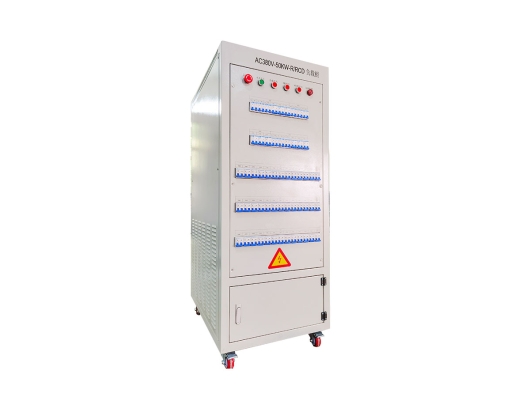
The GROADA AC380V-50KW-R/RCD inverter test load bank is a high-performance testing device specifical...
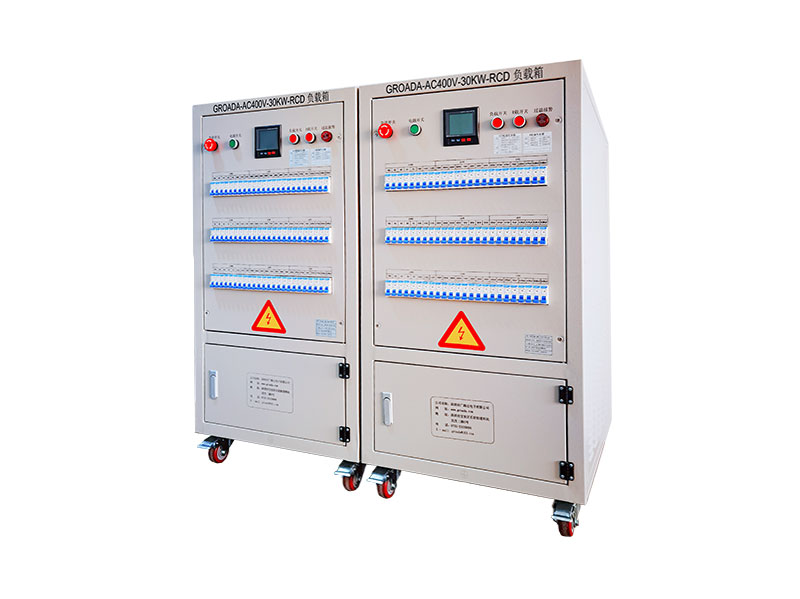
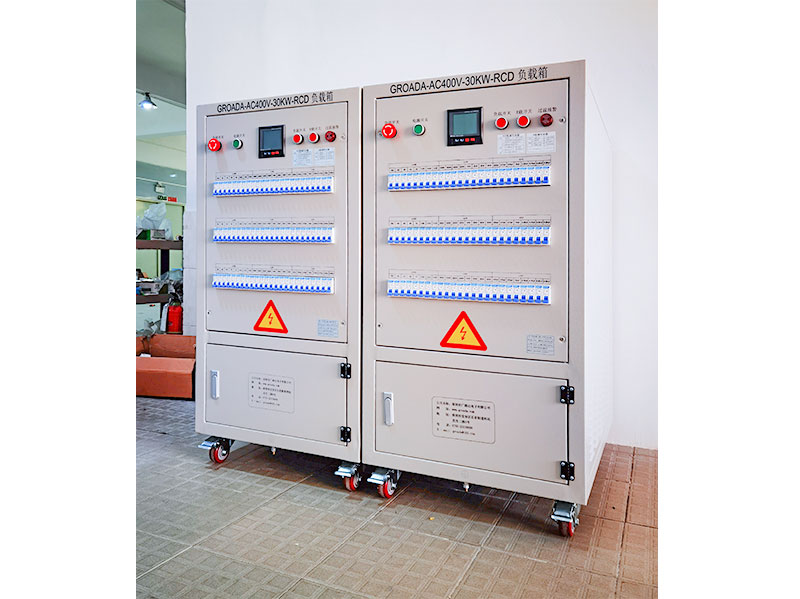
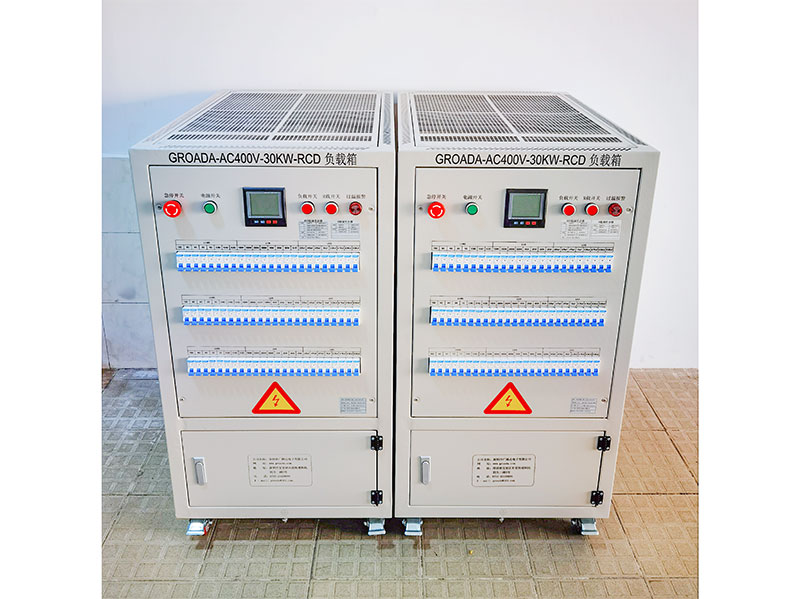
| Modèle | AC220V-5KW-RCD | AC220V-10KW-RCD | AC220V-15KW-RCD | AC220V-20KW-RCD | AC380V - 30KW-RCD | AC380V - 50KW-RCD | AC380V - 60KW-RCD | AC380V - 100KW-RCD | AC380V - 200KW-RCD |
| Puissance nominale | R = 5KW | R = 10KW | R = 15KW | R = 20KW | R = 30KW | R = 50KW | R = 60KW | R = 100KW | R = 200KW |
| RCD = 5KVA | RCD = 10KVA | RCD = 15KVA | RCD = 20KVA | RCD = 30KVA | RCD = 50KVA | RCD = 60KVA | RCD = 100KVA | RCD = 200KVA | |
| Courant d'entrée | 0 à 22A | 0 à 45A | 0 à 45A | 0 à 90A | 0 à 45A | 0 à 300A | 0 à 450A | 0 à 600A | 0 à 750A |
| Taille (largeur * profondeur * hauteur mm) | 500*600*800 | 500*600*1000 | 500*600*1100 | 500*750*1100 | 600*850*1400 | 600*850*1600 | 600*850*1850 | 700*1000*1800 | 1100*1400*1800 |
| Poids | 50 kg | 80 kg | 100 kilogrammes | 130 kg | 200 kg | 300 kg | 350kg | 450 kg | 550kg |
| Tension d'entrée | AC220 / 230V | AC380 / 400V | |||||||
| Autre tension d'entrée peut être personnalisée selon les exigences | |||||||||
| Chargement minimum | 100 watts | 100 watts | 100 watts | 100 watts | 100 watts | 1 kilowatt | 1 kilowatt | 1 kilowatt | 1 kilowatt |
| Autre puissance de charge minimale peut être personnalisée selon les exigences | |||||||||
| Précision globale | 3% (autres exigences de précision peuvent être personnalisées selon les exigences) | ||||||||
| facteur de puissance | PF = 0,6 ~ 1,0 | ||||||||
| coefficient de pic | 2 à 3 | ||||||||
| Mode de commande | Ordinateur hôte manuel local / à distance (mode de contrôle manuel local: disjoncteur / bouton / écran tactile trivial facultatif, d'autres méthodes peuvent être personnalisées au besoin) | ||||||||
| Interface à distance | RS232/RS485/USB/RJ45/CAN/GPIB (autres modes d'interface peuvent être personnalisés selon les exigences) | ||||||||
| Fonction de protection | Protection contre l'arrêt d'urgence, protection contre la surtempérature, protection contre l'interverrouillage de la charge du ventilateur, protection contre la mise à la terre (sélectionnez la protection contre la surtension, la protection contre le surcourant, la protection contre le court-circuit, la surcharge du ventilateur, le volume d'air insuffisant) | ||||||||
| Alimentation électrique de travail | AC220V | AC220V / AC380V | |||||||
| Précision de l'affichage | Niveau 0,5 (autre précision explicite peut être personnalisée selon les exigences) | ||||||||
| Paramètres d'affichage | Voltage, courant, puissance, fréquence, facteur de puissance, etc. (autres méthodes explicites peuvent être personnalisées selon les exigences) | ||||||||
| Froid façon sûre | Entrée d'air latérale et sortie d'air supérieure (d'autres méthodes de sortie d'air peuvent être personnalisées selon les exigences) | ||||||||
| Niveau de protection | IP20 (autre niveau de protection peut être personnalisé selon les exigences) | ||||||||
| Couleur d'apparence | RAL7035 (autres couleurs peuvent être personnalisées selon les exigences) | ||||||||
| Température de travail | -10 ℃ ~ 55 ℃ | ||||||||
| Humidité relative | ≤95% RH | ||||||||
| Altitude | ≤ 2500 m | ||||||||
Dans l’électronique de puissance et les systèmes d’énergie renouvelable, une vérification précise des performances des onduleurs est indispensable. LeAC 400 V / 30 kW RCD Inverter Banque de chargeest conçu pour fournir des charges d'essai fiables et contrôlables pour la validation, le diagnostic et l'étalonnage des onduleurs. Ce produit est conçu pour une utilisation en R& D, environnements de contrôle de qualité, de fabrication et de service sur le terrain.
Cette page explique les principes techniques, les cas d'utilisation d'essai, les spécifications de performance et les meilleures pratiques de l'industrie, afin d'aider les ingénieurs, les chefs de projet et les décideurs à faire des choix éclairés.
Une banque de charge simule les charges électriques en tirant du courant contrôlé de l'onduleur sous test, convertissant la puissance tirée en chaleur (ou d'autres formes) tout en permettant la mesure de la tension, du courant, de la puissance, de l'efficacité et du comportement dynamique. En bref : il agit comme une « charge mannequine » contrôlée pour stresser l’onduleur et révéler des caractéristiques de performance.
Cela est analogue aux banques de charge standard utilisées pour les générateurs ou les systèmes UPS.
Lors des tests d'onduleurs (en particulier pour les systèmes photovoltaïques (PV), les moteurs ou les systèmes hybrides), une banque de charge aide à confirmer que l'onduleur peut:
Maintenir la sortie nominale sous pleine charge
Manipuler les changements de charge transitoires
Maintenir la qualité de la forme d'onde, la tension & stabilité de fréquence
Fonctions de protection de déclenchement (surcharge, surtension, surtempérature)
Fonctionner de manière fiable sur une durée prolongée ou sous stress climatique
Un test de charge précis est une étape clé avant de déployer des onduleurs sur le terrain pour assurer la sécurité, la fiabilité et la garantie.
Il existe généralement deux catégories de simulation de charge utilisées dans les tests d'onduleurs:
Charges passives / résistives — simple resistive loads (pure resistance) are straightforward, stable, and cost-effective. They are good for baseline performance tests.
Active / Reactive / Programmable Loads — more advanced loads that can emulate inductance, capacitance, motor-like behavior, varying power factor, transient behaviors, and bi-directional current flow. These are essential when testing inverters under realistic conditions (e.g. with motors, grid interactions).
For example, a programmable AC load (active AC load) can vary its impedance dynamically, enabling tests across different load scenarios (resistive, inductive, mixed).
The choice of load type depends on the target application (solar, electric vehicle, motor drive) and required test coverage.
Below is a suggested structure of specification and feature content you can adapt or extend for your product page.
| Parameter | Typical Value / Range | Importance / Notes |
|---|---|---|
| Nominal output voltage | 380–480 V AC (or adjustable around 400 V) | Must match inverter output voltage to avoid mismatch |
| Puissance nominale | 30 kW | Allows testing inverters up to this power class |
| Load control mode | Constant power / constant current / constant impedance | Versatility in various load profiles |
| Power factor range | 0.8 lag to 0.8 lead (or full range) | To emulate inductive or capacitive loads |
| Cooling method | Forced air / water-cooled | For thermal management under high load |
| Accuracy / measurement precision | e.g. ±0.5 % for current/voltage | Ensures accurate performance evaluation |
| Response time / dynamic bandwidth | e.g. <1 ms, or specified slew rate | Important for transient load changes |
| Protection & safety | Overload, overtemperature, overvoltage, short-circuit | Safeguards both load unit and inverter |
| Communication & control interfaces | RS-485, CAN, Ethernet, Modbus, SCPI | For remote control, automation, integration |
| Cooling / ambient support | Operation range (e.g. –20 °C to +60 °C) | Ensures performance under field-like conditions |
| Mechanical design | Compact modular racks, ease of integration | Facilitates adoption in test benches |
In your page, you can present these specifications clearly, with callouts (e.g. “Why this matters”), diagrams, and even downloadable PDF spec sheets.
You should also highlight unique selling points (USPs) such as:
Modular expansion (e.g. stacking load modules)
Fast dynamic response
High-precision measurement
Long-term durability (e.g. continuous full-load operation)
Safety certifications (CE, UL, etc.)
Ease of calibration and maintenance
These USPs help users compare your product against alternatives.
To strengthen E-E-A-T (especially Experience and Expertise), you should incorporate real-world use cases, test methodologies, and examples from industry. Below are four suggested scenarios:
In solar inverter R&D or production, load banks help validate output under varying irradiance, grid fluctuations, and load transients. You verify Maximum Power Point Tracking (MPPT) behavior, interaction with the grid (voltage/frequency synchronization).
You may simulate grid disturbances or ramp up/down loads to confirm inverter stability.
In electric vehicle or industrial motor drives, the inverter outputs to a motor. A load bank that can emulate motor behavior (inductive or dynamic load) is crucial, especially to test regenerative braking, transient response, or torque control. Active loads offer bi-directional current capability, enabling more realistic emulation.
You might also simulate load steps (rapid jerk in torque) and confirm that the inverter’s control loops recover properly.
To assess long-term reliability, the load bank is used to run continuous full-load or partial-load tests under temperature, humidity, vibration stress. Manufacturers like ATESTEO use climatic chambers to simulate environments from –60 °C to +160 °C during inverter testing.
Such tests help detect hidden defects (thermal drift, material fatigue, insulation issues) before field deployment.
In a production line environment, you may use the load bank to spot-check inverters, validate batch consistency, certify output under worst-case scenarios, or re-test returned units. The fast control interface allows automation and integration into manufacturing test benches.
Describing these concrete applications (with maybe anonymized client stories or case studies) strengthens credibility and usefulness of your page content.
To show experience and guide users, include a detailed “how-to” or best-practice section. This helps users trust your content as authoritative and actionable.
Preparation & Safety Checks
Confirm inverter is disengaged (no output)
Verify all safety interlocks
Check load bank calibration, cooling, cabling
Light Load / No-Load Baseline Test
Apply minimal resistive load (e.g. 5–10 % rating)
Check baseline behavior, waveform purity via oscilloscope
Verify no abnormal noise, heating, oscillation
Gradual Load Ramp-Up
Increase load in steps (e.g. 20 %, 50 %, 80 %, 100 %)
At each step, record voltage, current, real power, power factor, harmonic distortion
Monitor temperature, fan activity, internal protection thresholds
Full-Load Continuous Operation
Run for a designed dwell time (e.g. 1h, 4h, 8h)
Log any drift, dropouts, thermal stability
Confirm output remains within spec
Transient / Step-Change Tests
Suddenly change load (increase or decrease 20–50 %)
Observe response time, overshoot, oscillation
Verify inverter control stability
Overload & Fault Simulation (Optional)
Slightly exceed rated load to test protection
Induce fault (short) in controlled setup (if safety permits)
Confirm shutdown, alarm mechanisms
Cooling & Thermal Recovery Observation
After tests, allow cooldown
Monitor any residual heating or slow recovery
Data Analysis & Reporting
Compile results into charts (efficiency vs load, THD vs load, thermal profile)
Compare against design expectations, standards
You may reference general inverter testing guides (e.g. for pure sine wave inverters) as background.
Always derate load bank if ambient temperature is high
Ensure cable sizing to avoid voltage drop or overheating
Synchronize measurement devices (use proper instrumentation)
Periodically calibrate load modules to maintain accuracy
Use modular load bank design to scale capacity
Incorporate safety interlocks, ground references, emergency shutdown
Offering this detailed, stepwise methodology shows your team knows the domain—not just marketing fluff.
To add authority and context, you should reference broader market trends, statistics, or industry challenges. Below are suggestions you can expand:
The global inverter market (especially for solar, EV, and industrial drives) continues to grow at a robust CAGR, driving demand for reliable testing equipment (source: industry reports)
As inverters become more complex (multi-level topology, high switching frequency, integrated power electronics + control), the need for high-fidelity load banks (fast dynamic response, reactive load emulation) increases
In EV manufacturing, stringent qualification tests (e.g. ISO, automotive OEM standards) often mandate extended load testing under environmental stress
Renewable grid-interactive inverters must satisfy grid codes (anti-islanding, voltage/frequency ride-through), which means test systems must be able to emulate grid disturbances and loads
In many regions, warranty claims or field failures due to thermal stress or component drift can be mitigated by good pre-shipment load testing
You may want to cite recent market reports in your vertical to support such statements (e.g. “Solar inverter market size 2025–2030 forecasts” etc.).
Here you should deliver a persuasive, credibility-backed pitch, referencing your technical strengths and real-world validation:
Proven Reliability: Designed for continuous duty, with industrial-grade components, redundant cooling, and thermal protection.
High Precision & Diagnostics: Accurate metering, fine control steps, high-speed response for dynamic loads.
Modular & Scalable: Expandable modules allow you to satisfy 30 kW today, and scale to higher power in the future.
Integration & Automation: Full communication interfaces (Modbus, CAN, Ethernet) for linking to test benches, SCADA systems, or automated test sequences.
Safety & Compliance: Built according to major safety and quality standards; includes interlocks, alarms, protective features.
Support & Service: Backed by expert technical support, calibration services, and documentation.
You can further bolster this with customer testimonials, whitepapers, certification records, or case studies.
 01
01
The GROADA AC380V-50KW-R/RCD inverter test load bank is a high-performance testing device specifical...
 02
02
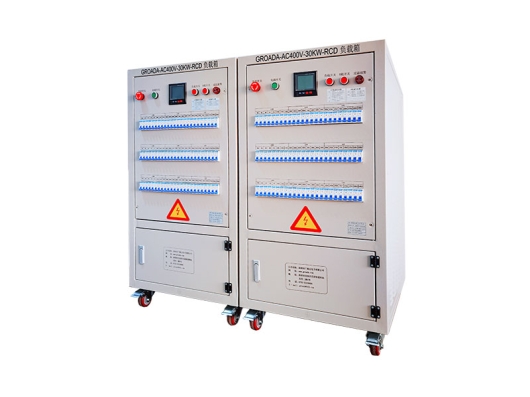
GROADA-AC400V-30KW-RCD Inverter AC Load_Shenzhen Guangluda Electronics Co., Ltd. is a high-tech ente...
 03
03
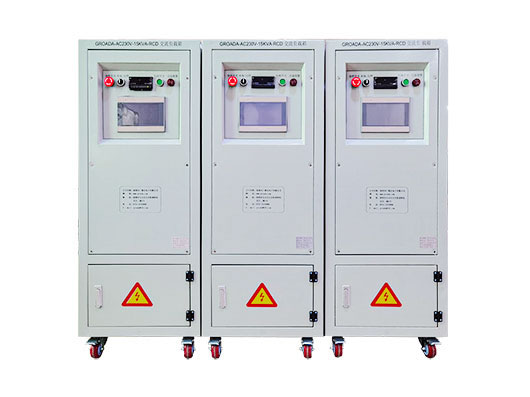
The GROADA AC Load Test Bench (AC230V, 15 kW, with Residual Current Device protection) is purpose-bu...
 04
04
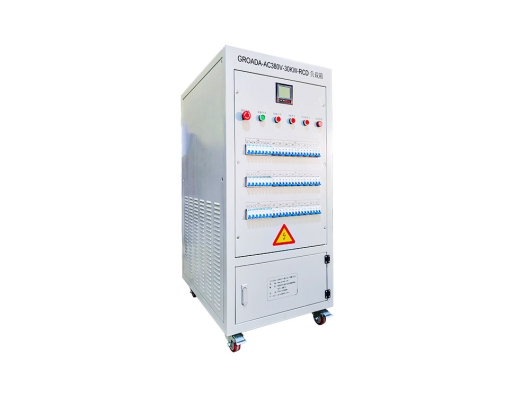
GROADA-AC380V-30KW-RCD Inverter Load Box_Shenzhen Guang Lu Da Electronics Co., Ltd. is a high-tech e...