Banque de charge d'onduleur GROADA-AC380V-50KW-R/RCD
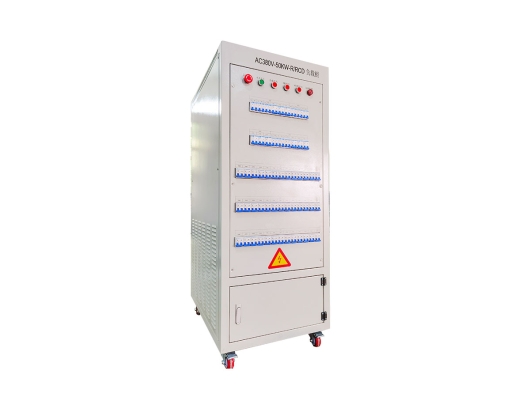
The GROADA AC380V-50KW-R/RCD inverter test load bank is a high-performance testing device specifical...
| Modèle | AC220V-5KW-RCD | AC220V-10KW-RCD | AC220V-15KW-RCD | AC220V-20KW-RCD | AC380V - 30KW-RCD | AC380V - 50KW-RCD | AC380V - 60KW-RCD | AC380V - 100KW-RCD | AC380V - 200KW-RCD |
| Puissance nominale | R = 5KW | R = 10KW | R = 15KW | R = 20KW | R = 30KW | R = 50KW | R = 60KW | R = 100KW | R = 200KW |
| RCD = 5KVA | RCD = 10KVA | RCD = 15KVA | RCD = 20KVA | RCD = 30KVA | RCD = 50KVA | RCD = 60KVA | RCD = 100KVA | RCD = 200KVA | |
| Courant d'entrée | 0 à 22A | 0 à 45A | 0 à 45A | 0 à 90A | 0 à 45A | 0 à 300A | 0 à 450A | 0 à 600A | 0 à 750A |
| Taille (largeur * profondeur * hauteur mm) | 500*600*800 | 500*600*1000 | 500*600*1100 | 500*750*1100 | 600*850*1400 | 600*850*1600 | 600*850*1850 | 700*1000*1800 | 1100*1400*1800 |
| Poids | 50 kg | 80 kg | 100 kilogrammes | 130 kg | 200 kg | 300 kg | 350kg | 450 kg | 550kg |
| Tension d'entrée | AC220 / 230V | AC380 / 400V | |||||||
| Autre tension d'entrée peut être personnalisée selon les exigences | |||||||||
| Chargement minimum | 100 watts | 100 watts | 100 watts | 100 watts | 100 watts | 1 kilowatt | 1 kilowatt | 1 kilowatt | 1 kilowatt |
| Autre puissance de charge minimale peut être personnalisée selon les exigences | |||||||||
| Précision globale | 3% (autres exigences de précision peuvent être personnalisées selon les exigences) | ||||||||
| facteur de puissance | PF = 0,6 ~ 1,0 | ||||||||
| coefficient de pic | 2 à 3 | ||||||||
| Mode de commande | Ordinateur hôte manuel local / à distance (mode de contrôle manuel local: disjoncteur / bouton / écran tactile trivial facultatif, d'autres méthodes peuvent être personnalisées au besoin) | ||||||||
| Interface à distance | RS232/RS485/USB/RJ45/CAN/GPIB (autres modes d'interface peuvent être personnalisés selon les exigences) | ||||||||
| Fonction de protection | Protection contre l'arrêt d'urgence, protection contre la surtempérature, protection contre l'interverrouillage de la charge du ventilateur, protection contre la mise à la terre (sélectionnez la protection contre la surtension, la protection contre le surcourant, la protection contre le court-circuit, la surcharge du ventilateur, le volume d'air insuffisant) | ||||||||
| Alimentation électrique de travail | AC220V | AC220V / AC380V | |||||||
| Précision de l'affichage | Niveau 0,5 (autre précision explicite peut être personnalisée selon les exigences) | ||||||||
| Paramètres d'affichage | Voltage, courant, puissance, fréquence, facteur de puissance, etc. (autres méthodes explicites peuvent être personnalisées selon les exigences) | ||||||||
| Froid façon sûre | Entrée d'air latérale et sortie d'air supérieure (d'autres méthodes de sortie d'air peuvent être personnalisées selon les exigences) | ||||||||
| Niveau de protection | IP20 (autre niveau de protection peut être personnalisé selon les exigences) | ||||||||
| Couleur d'apparence | RAL7035 (autres couleurs peuvent être personnalisées selon les exigences) | ||||||||
| Température de travail | -10 ℃ ~ 55 ℃ | ||||||||
| Humidité relative | ≤95% RH | ||||||||
| Altitude | ≤ 2500 m | ||||||||
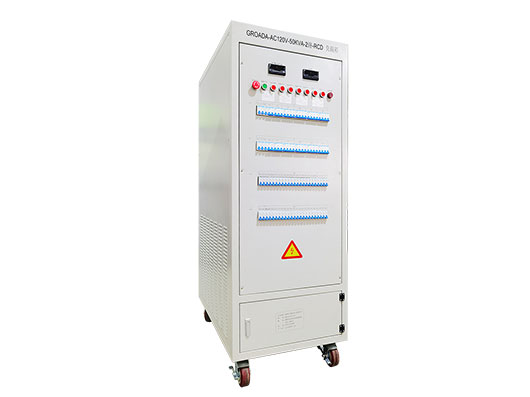
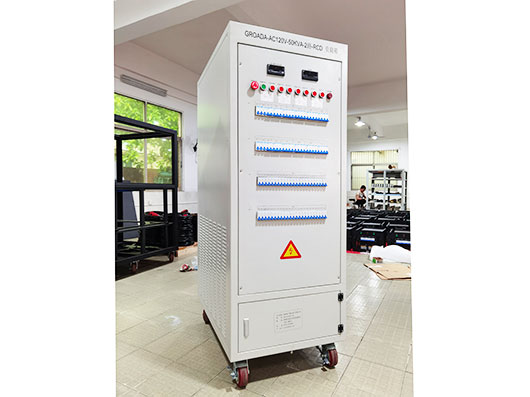
La banque de charge de l'inverseur RCD AC120V 50 kVA de GROADA est spécialement conçue pour les tests et la vérification de la charge de l'inverseur haute puissance. Il permet aux fabricants, aux intégrateurs de systèmes et aux laboratoires d'essai d'exécuter des tests à pleine charge, à charge partielle, transitoires et de passage en toute fiabilité et en toute sécurité. Cette banque de charge permet de valider les performances de l'onduleur dans des conditions réelles, assurant une production stable, une conformité et une fiabilité à long terme.
Manipulation haute puissance
Cette banque de charge supporte des charges continues et dynamiques jusqu'à 50 kVA à AC120V, ce qui la rend adaptée aux onduleurs moyens à grands ou aux réseaux d'onduleurs.
Intégration de protection RCD
Il comprend des fonctionnalités de sécurité RCD (dispositif à courant résiduel) pour protéger contre les fuites ou les défaillances au sol pendant les essais.
Niveaux de charge réglables
Les utilisateurs peuvent définir des charges progressives ou variables en continu, permettant la simulation de conditions de fonctionnement légères, moyennes et pleines.
Fast Response & Load Transitions
It can simulate fast load changes or step loads, which is essential to validate inverter transient response, recovery, and ride-through performance.
Precision Monitoring & Measurement
Integrated measurement modules capture voltage, current, power factor, efficiency, THD, flicker, and waveform distortion in real time.
Thermal Management & Protection
Equipped with temperature sensors, over-temperature protection, and cooling infrastructure to ensure stable operation over long-duration tests.
Modular & Expandable Design
The unit can be extended or modularized for higher power ratings or parallel operation, allowing flexible scaling.
Standards Compliance
Designed to meet safety and measurement standards (e.g. IEC, UL, etc.), ensuring the test environment is credible and trustworthy.
Even certified inverters may fail under real or stress conditions: in one industry test program, one-third of PV inverters failed key performance or safety tests despite having IEC/UL certification.
Using a load bank helps you uncover issues—such as thermal instability, waveform distortion, overcurrent trips, or inability to ride through transients—before field deployment.
To meet grid-codes or certification requirements (e.g. IEEE 1547.1 for distributed energy resources), inverter systems must pass a variety of stress and dynamic tests.
A robust load bank is essential to simulate worst-case grid or load conditions.
In production or R&D, load banks facilitate fast, repeatable testing cycles. This is especially valuable in automotive, PV, ESS (energy storage systems), or industrial applications where inverter reliability is critical.
The global end-of-line inverter testing market was valued at about USD 1.27 billion in 2024 and is expected to reach USD 2.85 billion by 2033, a strong CAGR of ≈ 9.4 %.
LePV inverter testing system market alone was valued at around USD 220 million in 2024 and is projected to grow to ~USD 450 million by 2033.
The overall inverter market (across sectors) is huge — valued at over USD 22 billion in 2024 and forecast to exceed USD 70+ billion by 2032, driven by renewables, electrification, and energy storage expansion.
These trends underscore that high-quality test infrastructure (like load banks) is increasingly indispensable.
Full-Load Endurance Tests
Run the inverter at rated output for prolonged periods to verify thermal stability, component degradation, and long-term reliability.
Partial-Load & Efficiency Mapping
Apply loads at, say, 25%, 50%, 75%, and 100% to map efficiency curves, power factor, and losses across operating range.
Transient & Step-Load Tests
Introduce sudden load changes (e.g. 10% → 80% → 30%) and monitor how the inverter handles transient events, recovery time, and waveform stability.
Ride-Through / Fault Simulation
Simulate grid disturbances, faults, or momentary interruptions and evaluate how the inverter maintains output or recovers — critical for compliance and stability.
Harmonic / Distortion Testing
Introduce non-pure loads or harmonic injection and assess how the inverter performs under nonlinear or distorted loads.
Multi-Unit / Parallel System Testing
For systems with multiple parallel inverter modules, test how they share load, respond to imbalance, or handle switching dynamics.
Load Type & Modeling
Use a mix of resistive, inductive, and capacitive loads to emulate real-world conditions. Many inverter tests require reactive power handling and realistic load emulation.
Instrumentation Accuracy
Ensure measurement modules are precise (e.g. ±0.1% class or better), especially for efficiency and power factor comparisons.
Thermal Derating
At high power, ambient temperature and internal heating can reduce effective load capacity — plan for margin or active cooling.
Transient Speed & Control Loop Interaction
The load bank must respond quickly and smoothly to test pulses so the inverter’s control system isn’t tricked by overly slow transitions.
Isolation & Safety
Proper galvanic isolation, overcurrent protection, and residual current detection (RCD) must be in place to safeguard test hardware and personnel.
Data Logging & Analysis
Capture high-resolution data (sampling ≥ 1 kHz or more) and provide software tools to analyze instability, harmonics, voltage dips, or anomalies.
Tailored for High-Power Inverters: Many load banks top out at a few tens of kW; 50 kVA at AC120V positions this unit well above standard commodity test rigs.
Safety-Centric Design: Built-in RCD protection helps mitigate faults and enhances confidence in testing environments.
Scalability & Flexibility: Its modular architecture allows future upgrades or parallel operation for larger systems.
Precision & Responsiveness: Designed for fast load steps and stable control, ideal for dynamic performance tests.
Proven Technology & Support: Backed by GROADA’s expertise and experience in power electronics testing.
 01
01
The GROADA AC380V-50KW-R/RCD inverter test load bank is a high-performance testing device specifical...
 02
02
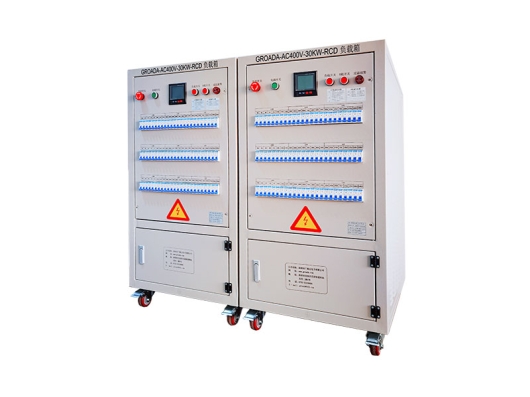
GROADA-AC400V-30KW-RCD Inverter AC Load_Shenzhen Guangluda Electronics Co., Ltd. is a high-tech ente...
 03
03
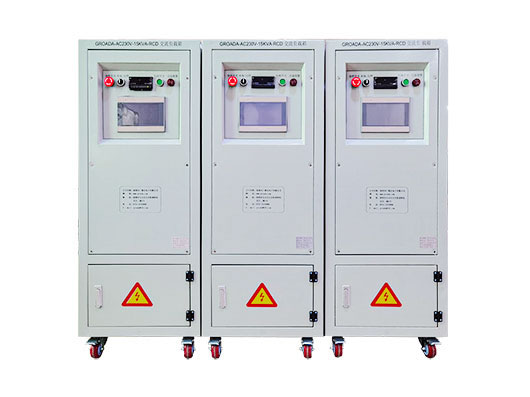
The GROADA AC Load Test Bench (AC230V, 15 kW, with Residual Current Device protection) is purpose-bu...
 04
04
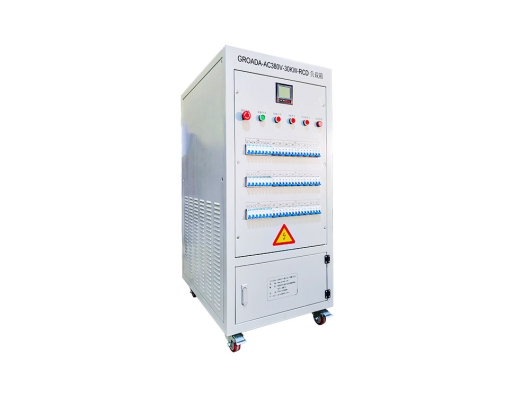
GROADA-AC380V-30KW-RCD Inverter Load Box_Shenzhen Guang Lu Da Electronics Co., Ltd. is a high-tech e...









