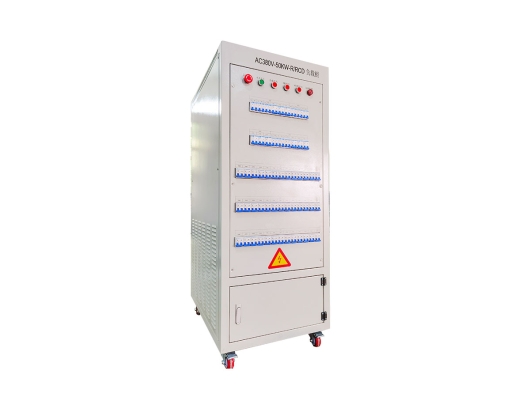
GROADA-AC380V-50KW-R/RCD omvormer laadbank
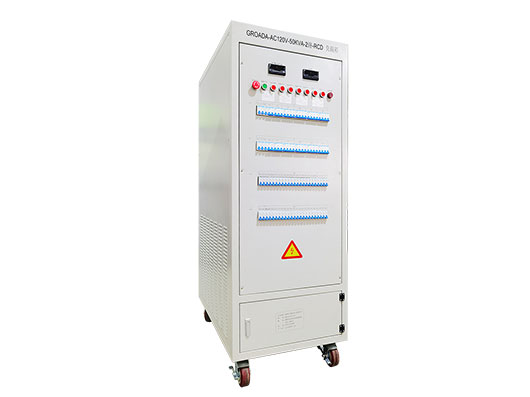
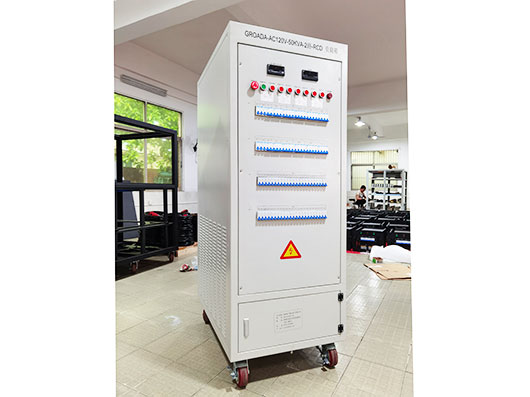
The GROADA AC380V-50KW-R/RCD inverter test load bank is a high-performance testing device specifical...
| Model | AC220V-5KW-RCD | AC220V-10KW-RCD | AC220V-15KW-RCD | AC220V-20KW-RCD | AC380V - 30KW-RCD | AC380V - 50KW-RCD | AC380V - 60KW-RCD | AC380V - 100KW-RCD | AC380V - 200KW-RCD |
| Nominale vermogen | R = 5KW | R = 10KW | R = 15KW | R = 20KW | R = 30KW | R = 50KW | R = 60KW | R = 100KW | R = 200KW |
| RCD = 5KVA | RCD = 10KVA | RCD = 15KVA | RCD = 20KVA | RCD = 30KVA | RCD = 50KVA | RCD = 60KVA | RCD = 100KVA | RCD = 200KVA | |
| Input stroom | 0-22A | 0-45A | 0-45A | 0-90A | 0-45A | 0-300A | 0-450A | 0-600A | 0-750A |
| Grootte (breedte * diepte * hoogte mm) | 500*600*800 | 500*600*1000 | 500*600*1100 | 500*750*1100 | 600*850*1400 | 600*850*1600 | 600*850*1850 | 700*1000*1800 | 1100*1400*1800 |
| gewicht | 50 kg | 80 kg | 100 kg | 130 kg | 200 kg | 300 kg | 350 kg | 450 kg | 550 kg |
| Ingangsspanning | AC220 / 230V | AC380 / 400V | |||||||
| Andere ingangsspanning kan volgens vereisten worden aangepast | |||||||||
| Minimale lading | 100W | 100W | 100W | 100W | 100W | 1kw | 1kw | 1kw | 1kw |
| Andere minimale laadmacht kan volgens vereisten worden aangepast | |||||||||
| Algemene nauwkeurigheid | 3% (andere nauwkeurigheidsvereisten kunnen volgens vereisten worden aangepast) | ||||||||
| vermogensfactor | PF = 0,6 ~ 1,0 | ||||||||
| piekcoëfficiënt | 2 tot 3 | ||||||||
| Controle modus | Lokale handmatige/externe gastcomputer (lokale handmatige besturingsmodus: schakelaar/knop/aanraakscherm drieweg optioneel, andere methoden kunnen worden aangepast zoals vereist) | ||||||||
| Interface op afstand | RS232/RS485/USB/RJ45/CAN/GPIB (andere interfacemodies kunnen volgens vereisten worden aangepast) | ||||||||
| Beschermingsfunctie | Bescherming tegen noodstop, bescherming tegen overtemperatuur, bescherming tegen ventilatorbelasting, bescherming tegen aarding (selecteer bescherming tegen overspanning, bescherming tegen overstroom, bescherming tegen kortsluiting, overbelasting van de ventilator, onvoldoende luchtvolume) | ||||||||
| Werkende voeding | AC220V | AC220V / AC380V | |||||||
| Vertoningsnauwkeurigheid | 0,5 niveau (andere expliciete precisie kan volgens vereisten worden aangepast) | ||||||||
| Weergave parameters | Spanning, stroom, vermogen, frequentie, vermogensfactor, enz. (andere expliciete methoden kunnen volgens vereisten worden aangepast) | ||||||||
| Koude zekere manier | Zijluchtingang en bovenluchtuitlaat (andere luchtuitlaatmethoden kunnen volgens vereisten worden aangepast) | ||||||||
| Beschermingsniveau | IP20 (andere beschermingsniveau kan volgens vereisten worden aangepast) | ||||||||
| Kleur van uiterlijk | RAL7035 (andere kleuren kunnen volgens vereisten worden aangepast) | ||||||||
| Werktemperatuur | -10 ℃ ~ 55 ℃ | ||||||||
| Relatieve vochtigheid | ≤95%RH | ||||||||
| Hoogte | ≤ 2500 m | ||||||||
De AC120V 50 kVA RCD Inverter Load Bank van GROADA is speciaal gebouwd voor het testen en verifiëren van de belasting van omvormers met hoge vermogen. Het stelt fabrikanten, systeemintegratoren en testlaboratoria in staat om full-load, part-load, transient en ride-through tests betrouwbaar en veilig uit te voeren. Deze laadbank helpt bij het valideren van de prestaties van de omvormer onder echte omstandigheden, waardoor stabiele output, naleving en betrouwbaarheid op lange termijn worden verzekerd.
Handling met hoge vermogen
Deze laadbank ondersteunt continue en dynamische belastingen tot 50 kVA bij AC120V, waardoor deze geschikt is voor middelgrote tot grote omvormers of omvormer-arrays.
RCD-beschermingsintegratie
Het bevat RCD (Residual Current Device) veiligheidsfuncties om te beschermen tegen lekkage of grondfouten tijdens het testen.
Verstelbare belastingsniveaus
Gebruikers kunnen stapsgewijze of continu variabele belastingen definiëren, waardoor simulatie van lichte, middelgrote en volledige bedrijfsomstandigheden mogelijk is.
Snelle reactie & Ladingsovergangen
Het kan snelle belastingsveranderingen of stappenbelastingen simuleren, wat essentieel is om de transiente respons, het herstel en de prestaties van de omvormer te valideren.
Precisiebewaking & Meting
Geïntegreerde meetmodules vastleggen spanning, stroom, vermogensfactor, efficiëntie, THD, flikker en golfvormvervorming in realtime.
Thermisch beheer & Bescherming
Uitgerust met temperatuursensoren, bescherming tegen overtemperatuur en koelinfrastructuur om een stabiele werking te garanderen tijdens langdurige tests.
Modulaire & Uitbreidbaar ontwerp
De eenheid kan worden uitgebreid of modulariseerd voor hogere nominale vermogen of parallelle werking, waardoor flexibele schaling mogelijk is.
Normen naleving
Ontworpen om te voldoen aan veiligheids- en meetnormen (bijvoorbeeld IEC, UL, enz.), waardoor de testomgeving geloofwaardig en betrouwbaar is.
Even certified inverters may fail under real or stress conditions: in one industry test program, one-third of PV inverters failed key performance or safety tests despite having IEC/UL certification.
Using a load bank helps you uncover issues—such as thermal instability, waveform distortion, overcurrent trips, or inability to ride through transients—before field deployment.
To meet grid-codes or certification requirements (e.g. IEEE 1547.1 for distributed energy resources), inverter systems must pass a variety of stress and dynamic tests.
A robust load bank is essential to simulate worst-case grid or load conditions.
In production or R&D, load banks facilitate fast, repeatable testing cycles. This is especially valuable in automotive, PV, ESS (energy storage systems), or industrial applications where inverter reliability is critical.
The global end-of-line inverter testing market was valued at about USD 1.27 billion in 2024 and is expected to reach USD 2.85 billion by 2033, a strong CAGR of ≈ 9.4 %.
DePV inverter testing system market alone was valued at around USD 220 million in 2024 and is projected to grow to ~USD 450 million by 2033.
The overall inverter market (across sectors) is huge — valued at over USD 22 billion in 2024 and forecast to exceed USD 70+ billion by 2032, driven by renewables, electrification, and energy storage expansion.
These trends underscore that high-quality test infrastructure (like load banks) is increasingly indispensable.
Full-Load Endurance Tests
Run the inverter at rated output for prolonged periods to verify thermal stability, component degradation, and long-term reliability.
Partial-Load & Efficiency Mapping
Apply loads at, say, 25%, 50%, 75%, and 100% to map efficiency curves, power factor, and losses across operating range.
Transient & Step-Load Tests
Introduce sudden load changes (e.g. 10% → 80% → 30%) and monitor how the inverter handles transient events, recovery time, and waveform stability.
Ride-Through / Fault Simulation
Simulate grid disturbances, faults, or momentary interruptions and evaluate how the inverter maintains output or recovers — critical for compliance and stability.
Harmonic / Distortion Testing
Introduce non-pure loads or harmonic injection and assess how the inverter performs under nonlinear or distorted loads.
Multi-Unit / Parallel System Testing
For systems with multiple parallel inverter modules, test how they share load, respond to imbalance, or handle switching dynamics.
Load Type & Modeling
Use a mix of resistive, inductive, and capacitive loads to emulate real-world conditions. Many inverter tests require reactive power handling and realistic load emulation.
Instrumentation Accuracy
Ensure measurement modules are precise (e.g. ±0.1% class or better), especially for efficiency and power factor comparisons.
Thermal Derating
At high power, ambient temperature and internal heating can reduce effective load capacity — plan for margin or active cooling.
Transient Speed & Control Loop Interaction
The load bank must respond quickly and smoothly to test pulses so the inverter’s control system isn’t tricked by overly slow transitions.
Isolation & Safety
Proper galvanic isolation, overcurrent protection, and residual current detection (RCD) must be in place to safeguard test hardware and personnel.
Data Logging & Analysis
Capture high-resolution data (sampling ≥ 1 kHz or more) and provide software tools to analyze instability, harmonics, voltage dips, or anomalies.
Tailored for High-Power Inverters: Many load banks top out at a few tens of kW; 50 kVA at AC120V positions this unit well above standard commodity test rigs.
Veiligheidsgericht ontwerp: Built-in RCD protection helps mitigate faults and enhances confidence in testing environments.
Scalability & Flexibility: Its modular architecture allows future upgrades or parallel operation for larger systems.
Precision & Responsiveness: Designed for fast load steps and stable control, ideal for dynamic performance tests.
Proven Technology & Support: Backed by GROADA’s expertise and experience in power electronics testing.
 01
01
The GROADA AC380V-50KW-R/RCD inverter test load bank is a high-performance testing device specifical...
 02
02
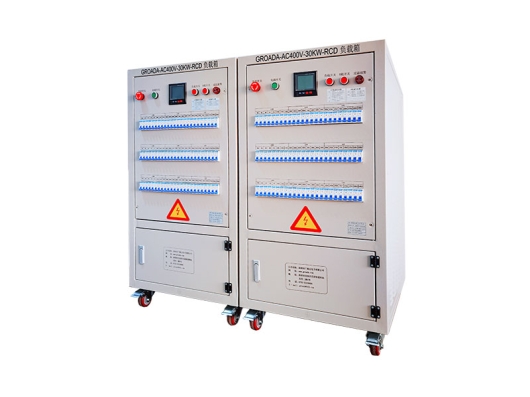
GROADA-AC400V-30KW-RCD Inverter AC Load_Shenzhen Guangluda Electronics Co., Ltd. is a high-tech ente...
 03
03
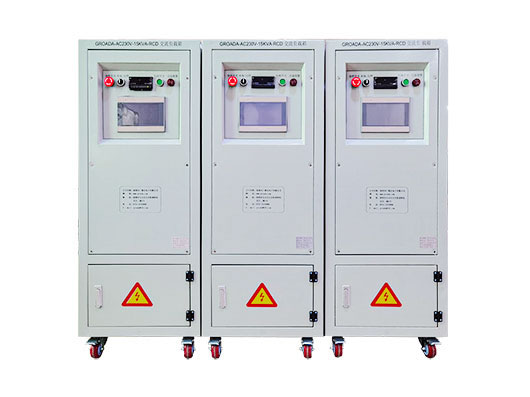
The GROADA AC Load Test Bench (AC230V, 15 kW, with Residual Current Device protection) is purpose-bu...
 04
04
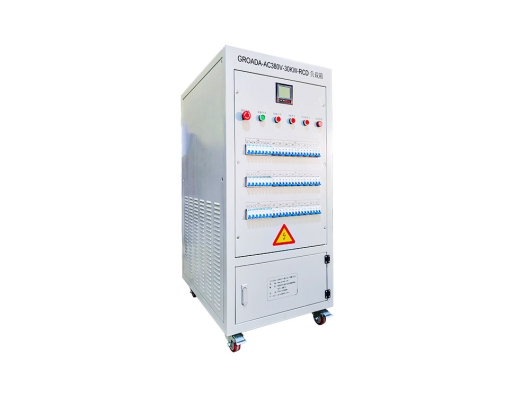
GROADA-AC380V-30KW-RCD Inverter Load Box_Shenzhen Guang Lu Da Electronics Co., Ltd. is a high-tech e...