GROADA-AC380V-50KW-R/RCD Wechselrichter Lastbank
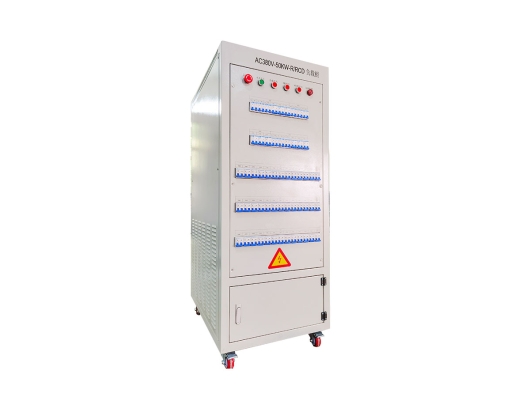
The GROADA AC380V-50KW-R/RCD inverter test load bank is a high-performance testing device specifical...
| Modell | AC220V-5KW-RCD | AC220V-10KW-RCD | AC220V-15KW-RCD | AC220V-20KW-RCD | AC380V - 30KW-RCD | AC380V - 50KW-RCD | AC380V - 60KW-RCD | AC380V - 100KW-RCD | AC380V - 200KW-RCD |
| Nennleistung | R = 5KW | R = 10KW | R = 15KW | R = 20KW | R = 30KW | R = 50KW | R = 60KW | R = 100KW | R = 200KW |
| RCD = 5KVA | RCD = 10KVA | RCD = 15KVA | RCD = 20KVA | RCD = 30KVA | RCD = 50KVA | RCD = 60KVA | RCD = 100KVA | RCD = 200KVA | |
| Eingangsstrom | 0 bis 22A | 0 bis 45A | 0 bis 45A | 0 bis 90A | 0 bis 45A | 0 bis 300A | 0-450A | 0 bis 600A | 0-750A |
| Größe (Breite * Tiefe * Höhe mm) | 500*600*800 | 500*600*1000 | 500*600*1100 | 500*750*1100 | 600*850*1400 | 600*850*1600 | 600*850*1850 | 700*1000*1800 | 1100*1400*1800 |
| Gewicht | 50 kg | 80 kg | 100 kg | 130kg | 200 kg | 300 kg | 350 kg | 450kg | 550kg |
| Eingangsspannung | AC220 / 230V | AC380 / 400V | |||||||
| Andere Eingangsspannung kann entsprechend Anforderungen angepasst werden | |||||||||
| Minimale Belastung | 100W | 100W | 100W | 100W | 100W | 1KW | 1KW | 1KW | 1KW |
| Andere Mindestlastleistung kann entsprechend Anforderungen angepasst werden | |||||||||
| Gesamtgenauigkeit | 3% (andere Genauigkeitsanforderungen können entsprechend Anforderungen angepasst werden) | ||||||||
| Leistungsfaktor | PF = 0,6 ~ 1,0 | ||||||||
| Spitzenkoeffizient | 2 bis 3 | ||||||||
| Steuermodus | Lokaler manueller / Remote-Hostcomputer (lokaler manueller Steuermodus: Schalter / Taste / Touchscreen dreiwegig optional, andere Methoden können nach Bedarf angepasst werden) | ||||||||
| Fernschnittstelle | RS232/RS485/USB/RJ45/CAN/GPIB (andere Schnittstellenmodi können entsprechend Anforderungen angepasst werden) | ||||||||
| Schutzfunktion | Notstandsschutz, Übertemperaturschutz, Lüfterlast-Verriegelungsschutz, Erdungsschutz (wählen Sie Überspannungsschutz, Überstromschutz, Kurzschlussschutz, Lüfterüberlast, unzureichendes Luftvolumen) | ||||||||
| Arbeitsstromversorgung | AC220V | AC220V / AC380V | |||||||
| Genauigkeit der Anzeige | 0,5 Ebene (andere explizite Präzision kann entsprechend Anforderungen angepasst werden) | ||||||||
| Anzeigeparameter | Spannung, Strom, Leistung, Frequenz, Leistungsfaktor usw. (andere explizite Methoden können entsprechend Anforderungen angepasst werden) | ||||||||
| Kalte sichere Weise | Seitenlufteinlass und oberer Luftauslass (andere Luftauslassmethoden können entsprechend Anforderungen angepasst werden) | ||||||||
| Schutzstufe | IP20 (andere Schutzebene können entsprechend Anforderungen angepasst werden) | ||||||||
| Erscheinungsfarbe | RAL7035 (andere Farben können entsprechend Anforderungen angepasst werden) | ||||||||
| Arbeitstemperatur | -10 ℃ ~ 55 ℃ | ||||||||
| Relative Luftfeuchtigkeit | ≤95% RH | ||||||||
| Höhe | ≤ 2500 m | ||||||||
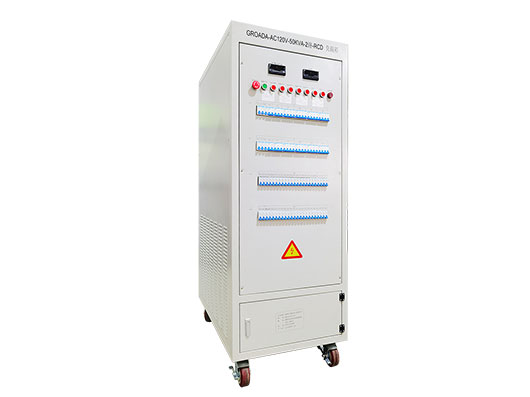
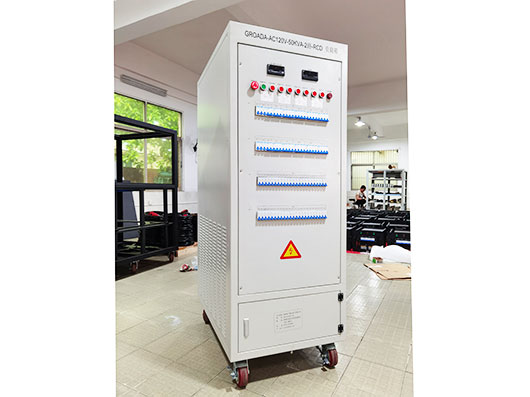
Die AC120V 50 kVA RCD Inverter Load Bank von GROADA ist speziell für die Hochleistungs-Inverterlastprüfung und -verifizierung entwickelt. Es ermöglicht es Herstellern, Systemintegratoren und Testlaboren, Volllast-, Teillast-, Übergangs- und Durchlauftests zuverlässig und sicher durchzuführen. Diese Lastbank hilft bei der Validierung der Leistung des Wechselrichters unter realen Bedingungen und gewährleistet eine stabile Leistung, Compliance und langfristige Zuverlässigkeit.
Hohe Leistung Handling
Diese Lastbank unterstützt kontinuierliche und dynamische Belastungen bis zu 50 kVA bei AC120V, was sie für mittlere bis große Wechselrichter oder Wechselrichterarys geeignet macht.
RCD Schutz Integration
Es umfasst RCD (Residual Current Device) Sicherheitsmerkmale zum Schutz vor Leckagen oder Bodenfehlern während der Prüfung.
Verstellbare Belastungsniveaus
Anwender können schrittweise oder kontinuierlich variable Lasten definieren, die Simulation von leichten, mittleren und vollen Betriebsbedingungen ermöglichen.
Fast Response & Load Transitions
It can simulate fast load changes or step loads, which is essential to validate inverter transient response, recovery, and ride-through performance.
Precision Monitoring & Measurement
Integrated measurement modules capture voltage, current, power factor, efficiency, THD, flicker, and waveform distortion in real time.
Thermal Management & Protection
Equipped with temperature sensors, over-temperature protection, and cooling infrastructure to ensure stable operation over long-duration tests.
Modular & Expandable Design
The unit can be extended or modularized for higher power ratings or parallel operation, allowing flexible scaling.
Standards Compliance
Designed to meet safety and measurement standards (e.g. IEC, UL, etc.), ensuring the test environment is credible and trustworthy.
Even certified inverters may fail under real or stress conditions: in one industry test program, one-third of PV inverters failed key performance or safety tests despite having IEC/UL certification.
Using a load bank helps you uncover issues—such as thermal instability, waveform distortion, overcurrent trips, or inability to ride through transients—before field deployment.
To meet grid-codes or certification requirements (e.g. IEEE 1547.1 for distributed energy resources), inverter systems must pass a variety of stress and dynamic tests.
A robust load bank is essential to simulate worst-case grid or load conditions.
In production or R&D, load banks facilitate fast, repeatable testing cycles. This is especially valuable in automotive, PV, ESS (energy storage systems), or industrial applications where inverter reliability is critical.
Das globaleend-of-line inverter testing market was valued at about USD 1.27 billion in 2024 and is expected to reach USD 2.85 billion by 2033, a strong CAGR of ≈ 9.4 %.
DiePV inverter testing system market alone was valued at around USD 220 million in 2024 and is projected to grow to ~USD 450 million by 2033.
The overall inverter market (across sectors) is huge — valued at over USD 22 billion in 2024 and forecast to exceed USD 70+ billion by 2032, driven by renewables, electrification, and energy storage expansion.
These trends underscore that high-quality test infrastructure (like load banks) is increasingly indispensable.
Full-Load Endurance Tests
Run the inverter at rated output for prolonged periods to verify thermal stability, component degradation, and long-term reliability.
Partial-Load & Efficiency Mapping
Apply loads at, say, 25%, 50%, 75%, and 100% to map efficiency curves, power factor, and losses across operating range.
Transient & Step-Load Tests
Introduce sudden load changes (e.g. 10% → 80% → 30%) and monitor how the inverter handles transient events, recovery time, and waveform stability.
Ride-Through / Fault Simulation
Simulate grid disturbances, faults, or momentary interruptions and evaluate how the inverter maintains output or recovers — critical for compliance and stability.
Harmonic / Distortion Testing
Introduce non-pure loads or harmonic injection and assess how the inverter performs under nonlinear or distorted loads.
Multi-Unit / Parallel System Testing
For systems with multiple parallel inverter modules, test how they share load, respond to imbalance, or handle switching dynamics.
Load Type & Modeling
Use a mix of resistive, inductive, and capacitive loads to emulate real-world conditions. Many inverter tests require reactive power handling and realistic load emulation.
Instrumentation Accuracy
Ensure measurement modules are precise (e.g. ±0.1% class or better), especially for efficiency and power factor comparisons.
Thermal Derating
At high power, ambient temperature and internal heating can reduce effective load capacity — plan for margin or active cooling.
Transient Speed & Control Loop Interaction
The load bank must respond quickly and smoothly to test pulses so the inverter’s control system isn’t tricked by overly slow transitions.
Isolation & Safety
Proper galvanic isolation, overcurrent protection, and residual current detection (RCD) must be in place to safeguard test hardware and personnel.
Data Logging & Analysis
Capture high-resolution data (sampling ≥ 1 kHz or more) and provide software tools to analyze instability, harmonics, voltage dips, or anomalies.
Tailored for High-Power Inverters: Many load banks top out at a few tens of kW; 50 kVA at AC120V positions this unit well above standard commodity test rigs.
Sicherheitszentrisches Design: Built-in RCD protection helps mitigate faults and enhances confidence in testing environments.
Scalability & Flexibility: Its modular architecture allows future upgrades or parallel operation for larger systems.
Precision & Responsiveness: Designed for fast load steps and stable control, ideal for dynamic performance tests.
Proven Technology & Support: Backed by GROADA’s expertise and experience in power electronics testing.
 01
01
The GROADA AC380V-50KW-R/RCD inverter test load bank is a high-performance testing device specifical...
 02
02
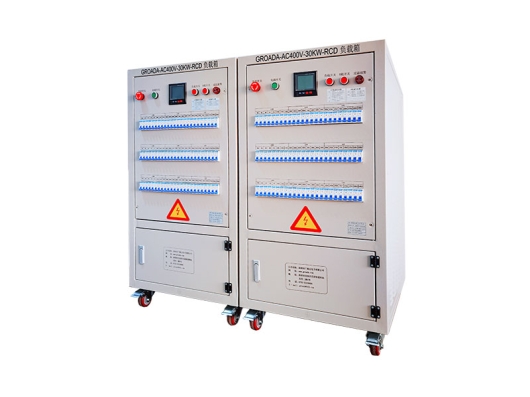
GROADA-AC400V-30KW-RCD Inverter AC Load_Shenzhen Guangluda Electronics Co., Ltd. is a high-tech ente...
 03
03
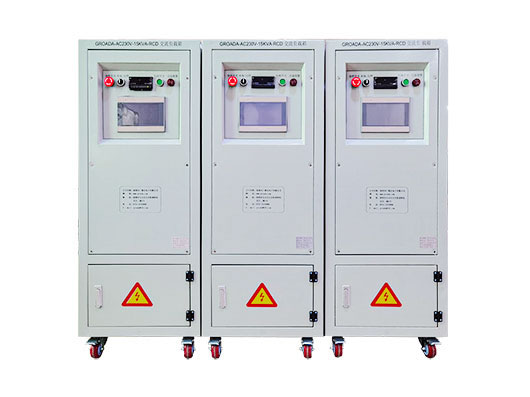
The GROADA AC Load Test Bench (AC230V, 15 kW, with Residual Current Device protection) is purpose-bu...
 04
04
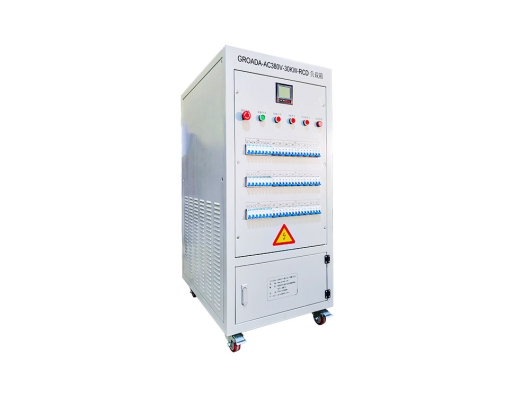
GROADA-AC380V-30KW-RCD Inverter Load Box_Shenzhen Guang Lu Da Electronics Co., Ltd. is a high-tech e...









