
Load bank testing plays a critical role in validating the performance, stability, and reliability of microgrid systems—especially during commissioning, maintenance, or grid interconnection verification. A single-line diagram (SLD) is often used as the foundational schematic for designing and analyzing how a load bank integrates into a microgrid’s power flow, ensuring accurate representation of electrical connections, protection coordination, and operational scenarios.
When deploying a load bank in a microgrid context—whether resistive, reactive, or combined RLC types—it must be properly modeled on the SLD to reflect real-world load conditions such as constant power draw, dynamic response under transient loads, or voltage/frequency regulation. This allows engineers to simulate full-load testing without relying on actual utility demand, which is both cost-effective and safe.
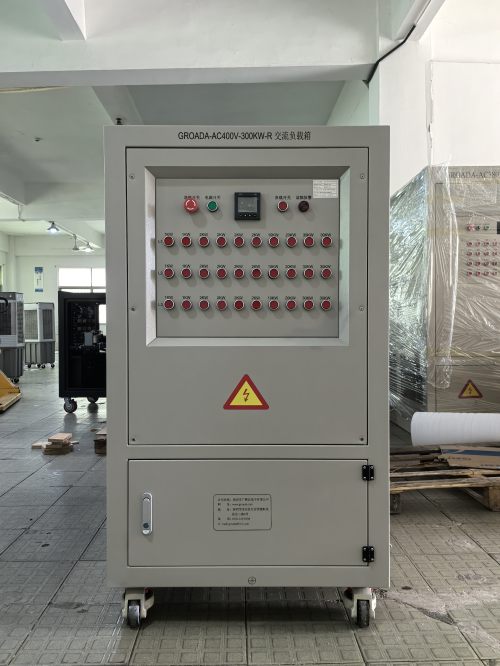
For example, during factory acceptance testing (FAT) of a solar-plus-storage microgrid system, a portable resistive load bank can be connected via the single line to apply 100% of rated generator output, verifying that inverters, battery management systems, and control logic respond correctly to full-load conditions. In another scenario, a reactive load bank may be added to test VAR support capability—a crucial requirement for maintaining voltage stability in weak grids.
Modern load banks are equipped with remote monitoring via Modbus TCP or CAN bus interfaces, enabling integration with SCADA systems and digital twins of the microgrid. These capabilities enhance the precision of test results, reduce manual intervention, and support predictive maintenance strategies. Standards like IEC 60034-1 (for motor/generator testing) and IEEE 1547 (for distributed energy resource interconnection) guide the design and execution of such tests, ensuring compliance with safety and performance benchmarks.
Case Study (Anonymized): A 500 kW microgrid in a remote island community used a three-phase resistive load bank connected per the single-line diagram to verify diesel generator ramp rates, synchronization timing, and black-start capability before grid connection. The test confirmed that all protective relays operated within specified tolerances, reducing downtime risk by 90%.
This approach ensures robustness across applications—from renewable energy integration to backup power validation—making single-line-based load bank testing an indispensable practice for modern microgrids.