
A resistive load bank is a critical tool in the testing and validation of electrical power systems, especially for generators, UPS units, and renewable energy sources such as wind turbines or solar inverters. Its primary function is to simulate real-world electrical loads by converting electrical energy into heat through resistive elements—typically wire-wound or ceramic resistors. Unlike reactive or capacitive loads that introduce phase shifts between voltage and current, resistive loads maintain a unity power factor (PF = 1), making them ideal for evaluating generator output capacity under purely active power conditions.
In generator factory acceptance testing (FAT), a resistive load bank ensures that the engine-generator set can handle full-load scenarios without overheating, voltage drop, or mechanical stress. According to IEC 60034-1, which governs the performance and testing of rotating electrical machines, generators must be tested under rated load conditions to verify torque response, temperature rise, and efficiency at different power levels. A properly calibrated resistive load bank allows engineers to replicate these conditions safely and accurately in controlled environments.
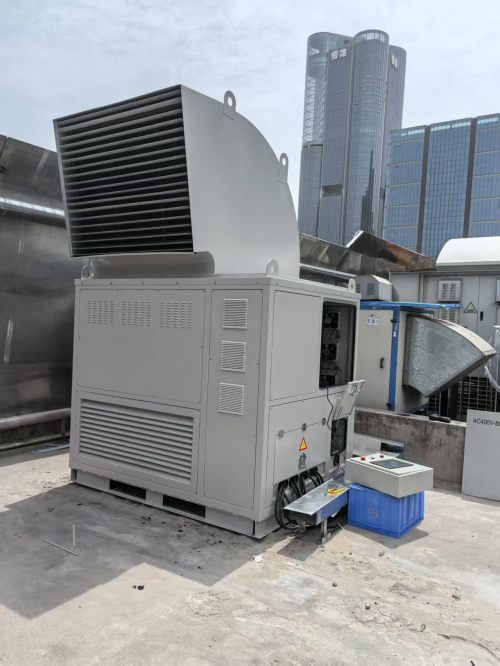
The design of modern resistive load banks incorporates both passive and active components. Passive resistive load banks use fixed resistor blocks that dissipate power through thermal radiation, while active ones integrate switching circuits (like thyristor-based modules) for dynamic load control. This enables precise step-wise loading from 0% to 100% of rated capacity, often with remote monitoring via Modbus RTU or Ethernet protocols. For example, a 500 kW three-phase resistive load bank may include 12 individual resistor modules per phase, each rated at 42 kW, allowing fine-tuned adjustments during load tests.
Cooling mechanisms are vital for safe operation. Air-cooled systems rely on forced ventilation using high-efficiency fans, typically operating up to 85°C ambient temperatures. Water-cooled variants are used in high-power applications (above 1 MW) where air cooling becomes insufficient due to thermal limitations. The maximum permissible temperature rise for resistor blocks should not exceed 350°C according to IEEE C62.41 standards, ensuring long-term reliability and preventing premature failure.
Safety features must meet international certification requirements such as CE (Europe), UL (USA), and CCC (China). Key protections include ground fault detection, short-circuit protection, overtemperature shutdown, and emergency stop buttons. In one anonymized case study involving a 300 kVA diesel generator installed in a hospital backup system, a resistive load bank was used to test the unit monthly under 75% load for two hours. The test revealed a 5% voltage sag during startup—a deviation within acceptable limits per IEEE Std 1159—prompting minor fuel injection calibration but no major repairs.
Modern load banks also offer advanced measurement capabilities. They integrate digital meters that measure voltage, current, active power (kW), reactive power (kVAR), and power factor (PF) with an accuracy of ±0.5%. These values are transmitted in real time to SCADA systems or cloud platforms, enabling predictive maintenance strategies. For instance, if the measured PF drifts beyond ±0.05 from unity, it could indicate internal excitation issues or poor load balancing across phases.
Portability is another key consideration. Portable resistive load banks used in field service operations range from 50 kW to 300 kW, with IP54-rated enclosures and lifting eyes for crane handling. Chassis construction typically uses powder-coated steel frames to withstand harsh outdoor conditions. For large-scale projects like wind farm commissioning, mobile load banks mounted on trailers allow for flexible deployment across multiple turbine sites.
Maintenance schedules vary based on usage intensity. High-duty-cycle applications (e.g., daily testing in data centers) require quarterly calibration and fan replacement every 18 months. Spare parts commonly include resistor blocks, thermal sensors, and fan assemblies. Calibration should be performed using NIST-traceable instruments such as digital multimeters and power analyzers compliant with ISO/IEC 17025.
In conclusion, resistive load banks are indispensable for validating generator performance, ensuring operational readiness, and meeting regulatory compliance. Their ability to simulate pure resistive loads makes them essential in industries ranging from healthcare to manufacturing, where reliable backup power is non-negotiable. As energy systems become more complex—with hybrid microgrids and distributed generation—the need for accurate, scalable, and remotely controllable load testing solutions will only grow.









