
Portable load banks are essential tools for verifying the performance and reliability of electrical power systems, including generators, uninterruptible power supplies (UPS), and renewable energy sources like wind or solar farms. These devices simulate real-world electrical loads to ensure that equipment operates safely under various conditions—from full capacity to partial load scenarios—before it is deployed in critical infrastructure environments.
A portable resistive load bank is the most common type, offering stable, predictable resistance across all phases. It is ideal for testing diesel or natural gas generators during factory acceptance tests (FAT) or routine maintenance. For more advanced applications, a three-phase reactive load bank can be used to test power factor correction systems or validate inductive loads such as motors and transformers. Combined RLC (Resistive-Inductive-Capacitive) load banks offer even greater flexibility, enabling engineers to mimic complex grid behaviors in microgrid integration projects or during commissioning of hybrid energy systems.
Key technical specifications include rated power from 5 kW up to 2,000 kVA, voltage levels from 120 VAC to 690 VAC, and phase configurations (single or three-phase). Modern units feature built-in digital meters for accurate measurement of active power (kW), reactive power (kVAR), apparent power (kVA), current, voltage, and power factor—with typical accuracy within ±0.5%. Cooling methods vary: air-cooled models rely on high-efficiency fans and heat sinks, while water-cooled systems are better suited for continuous operation at high loads (>80% of rated capacity).
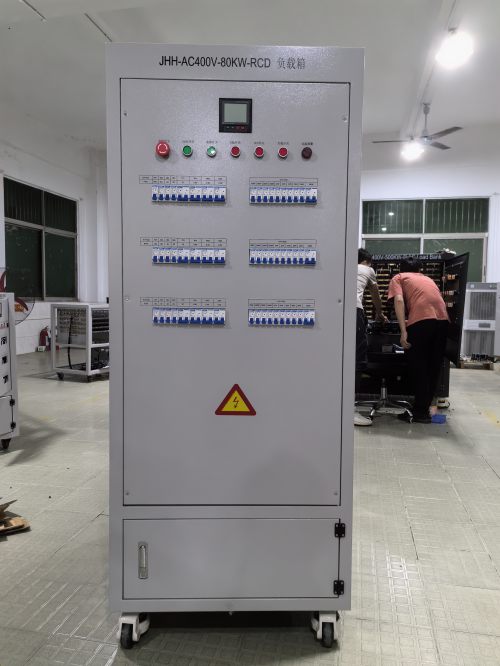
Safety is paramount. All modern portable load banks comply with IEC 60034-1 and UL/CSA standards, featuring emergency stop buttons, overtemperature protection, short-circuit safeguards, and grounding integrity checks. Remote monitoring via Modbus TCP or RS-485 enables automated data logging and fault detection in remote locations. Many units also support cloud-based dashboards for real-time diagnostics by field technicians or central operations teams.
An anonymized case study from a utility-scale solar farm showed that using a 1,200 kVA three-phase resistive-reactive load bank allowed engineers to verify generator synchronization timing and voltage regulation stability prior to grid interconnection—reducing commissioning time by 40% compared to traditional step-loading methods.
For optimal results, regular calibration every 12 months is recommended using NIST-traceable instruments, along with inspection of resistor blocks and fan assemblies for wear. A well-maintained load bank ensures long-term accuracy and prevents costly downtime during actual power events.