
Reactive load banks are essential tools in the testing and validation of electrical power systems, particularly for generators, uninterruptible power supplies (UPS), and renewable energy inverters. Unlike resistive load banks that simulate real-world resistive loads such as lighting or heating, reactive load banks emulate inductive or capacitive loads—common in motors, transformers, and industrial equipment—allowing engineers to assess system performance under realistic reactive power conditions.
A well-designed reactive load bank typically consists of a bank of inductors or capacitors, often arranged in a three-phase configuration to match the power distribution system being tested. These components can be switched on or off via solid-state relays or contactors to provide stepwise control over the reactive power draw (measured in kVAR). Modern designs incorporate thermal management systems, such as forced-air cooling with variable-speed fans, to ensure safe operation during extended tests. For higher power applications, water-cooled versions are used to manage heat dissipation more effectively.
Safety is paramount in reactive load bank design. Compliance with IEC 60034-1 and IEEE 115 standards ensures proper motor and generator behavior under varying power factor conditions. Protection features like overcurrent, overtemperature, and short-circuit detection must be integrated into the control circuitry. Additionally, grounding integrity, emergency stop functionality, and CE/UL certification are non-negotiable for commercial and industrial deployment.
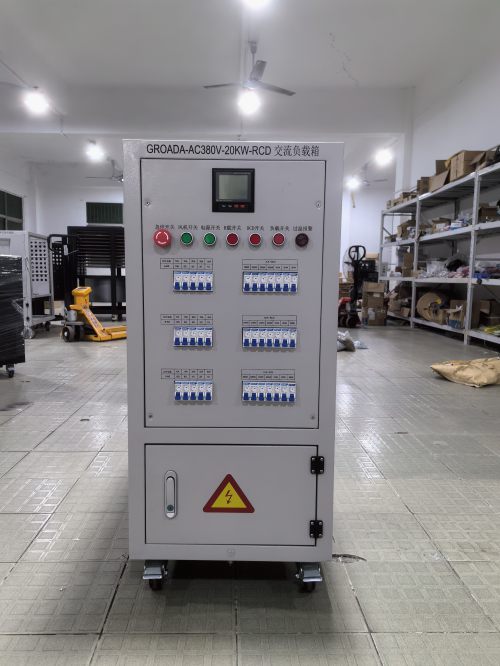
Control interfaces such as Modbus RTU or Ethernet enable remote monitoring and automation, making these systems ideal for factory acceptance testing (FAT) and field commissioning. In one anonymized case study, a 500 kVA diesel generator was tested using a combination resistive-reactive load bank at 0.8 lagging power factor for 8 hours. The test verified voltage regulation stability within ±2% and confirmed that the generator’s AVR system could maintain consistent output despite load variations—a critical metric for grid-connected microgrids.
The design must also consider portability, especially for field engineers. Lightweight chassis with IP54 ratings and lifting eyes improve transport safety and environmental resilience. Calibration cycles of every 12 months, along with replacement schedules for resistor blocks and fan assemblies, ensure long-term measurement accuracy.
In summary, reactive load bank design balances electrical performance, thermal efficiency, safety compliance, and operational flexibility to meet the demands of modern power systems—from legacy infrastructure to next-generation smart grids.