
Commissioning a new power station is a high-stakes exercise. Before a generator, UPS, or turbine is signed off, it must prove that it can deliver rated output under controlled, repeatable load conditions. This is where a high precision load bank becomes indispensable. During the acceptance test, the load bank simulates real electrical demand, verifies capacity, exposes weak connections, and validates protection settings—all without connecting to the live grid. In this article, our engineering team shares the top 6 load bank solutions we recommend for power station acceptance testing, along with the technical criteria that separate a reliable unit from a risky one.
Why Precision Matters in Acceptance Testing
An acceptance test is a legal and contractual milestone. If the measured power, voltage, frequency, or power factor drifts because of an inaccurate load bank, the entire test result becomes questionable. A high precision load bank typically holds load accuracy within ±1% and supports fine-step adjustment, allowing engineers to load a generator gradually from 0% to 110% of rated capacity. This controlled ramp reveals transient response, governor stability, cooling performance, and the ability to reject sudden load steps—exactly the behaviors a site owner needs documented before energization.
1. Resistive Load Bank for Full-Power Verification
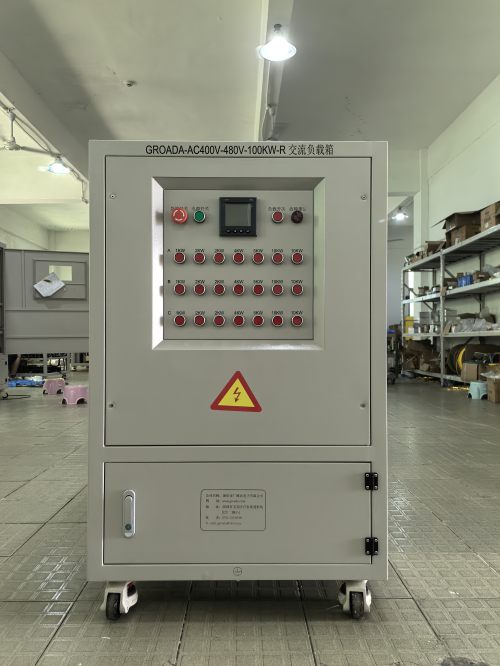
The resistive load bank is the workhorse of any acceptance test. It converts electrical energy into heat through high-grade nickel-chromium resistive elements, drawing current at unity power factor. This lets engineers confirm that a generator can produce 100% of its kilowatt rating continuously. Our recommended resistive units feature stainless-steel sheathed elements, forced-air cooling with over-temperature protection, and load steps as fine as 5 kW. For power station commissioning, a resistive load bank is the fastest way to prove real-power output and heat rejection under sustained full load.
2. Reactive Load Bank for Power Factor Testing
Real generators rarely serve purely resistive loads. A reactive (inductive) load bank introduces lagging power factor, typically 0.8, so the alternator and automatic voltage regulator are tested under the same stress they will experience in service. This verifies excitation headroom, voltage stability, and thermal margins in the windings. Pairing a reactive unit with a resistive unit gives a combined kVA loading profile that closely mirrors the real installation—an essential step for turnkey acceptance of large standby plants.
3. Combined Resistive-Reactive Load Bank
For sites that want a single, integrated solution, the combined resistive-reactive load bank offers the best of both worlds. In one enclosure, engineers can dial in any combination of kW and kVAR, testing across the full four-quadrant capability curve of the generator. This is our top pick for medium to large power stations because it reduces cabling, saves setup time, and delivers a complete load profile from a single controller. Modern combined units include programmable test sequences, so a full acceptance protocol can run automatically and log every data point.
4. AC Load Bank for UPS and Switchgear Validation
Power station acceptance is not only about generators. UPS systems, static transfer switches, and low-voltage switchgear also require proof of performance. A dedicated AC load bank applies stable, adjustable load to these assets, confirming battery autonomy, transfer times, and thermal behavior. High precision current and voltage sensing ensures the recorded runtime and efficiency figures are defensible during the handover audit.
5. DC Load Bank for Battery and Rectifier Systems
Substations and power plants rely on DC battery banks for control, protection, and emergency operation. A DC load bank discharges these batteries at a controlled current to measure real capacity and identify weak cells before they fail in service. Precision constant-current control, adjustable cut-off voltage, and integrated data logging make the DC load bank a critical tool for verifying that station DC systems meet their specified ampere-hour rating.
6. Portable High Precision Load Bank
Not every acceptance test happens in an accessible plant room. Rooftop generators, containerized power modules, and remote substations demand mobility. Our portable high precision load bank packages accurate loading, digital metering, and safety interlocks into a compact, wheeled or lifting-lug enclosure. Despite its size, it retains laboratory-grade accuracy, giving field engineers confidence that a portable test carries the same weight as a fixed installation test.
Key Technical Features to Demand
When selecting a load bank for power station acceptance, our engineers prioritize the following: load accuracy within ±1%, fine load-step resolution, robust over-temperature and reverse-power protection, redundant cooling with airflow monitoring, and a digital control system that records kW, kVAR, kVA, voltage, current, frequency, and power factor in real time. Data export via USB or Ethernet allows the acceptance report to be generated automatically, reducing human error and speeding up sign-off.
Safety and Compliance
A load bank handles the full output of the equipment under test, so safety cannot be an afterthought. Look for units with emergency stop, phase-loss detection, ground-fault monitoring, and enclosure ratings suited to the site environment. Compliance with recognized standards ensures the test results are accepted by consultants, insurers, and regulators. A well-designed high precision load bank protects both the personnel running the test and the expensive asset being commissioned.
Choosing the Right Partner
The best load bank is only as good as the engineering support behind it. As a dedicated load bank manufacturer, we help clients match capacity, voltage class, cooling method, and control features to their specific acceptance protocol. From single resistive units to fully automated combined systems, the right high precision load bank turns a stressful commissioning day into a smooth, well-documented milestone. Investing in accurate, reliable load testing today prevents costly failures once the power station is energized and serving critical loads.
Conclusion
Power station acceptance testing leaves no room for uncertainty. Whether you need to verify real power with a resistive load bank, test power factor with a reactive unit, validate DC batteries, or run a full automated sequence with a combined system, choosing a high precision load bank ensures your results are accurate, repeatable, and defensible. These top 6 solutions cover the complete spectrum of acceptance testing needs, giving engineers the confidence to certify that every kilowatt and every kilovar performs exactly as specified.









