
Field engineers, rental fleet operators, and commissioning teams all face the same challenge: how to verify the true performance of a generator, UPS, or turbine when the equipment is installed on-site and cannot be moved to a laboratory. A compact portable load bank is the answer. Small enough to fit in a service van, rugged enough to survive gravel yards and rooftop plant rooms, and powerful enough to deliver a genuine full-load test, these units have become indispensable tools for modern power testing. In this technical guide we review our top four compact portable load banks engineered specifically for field on-site testing, and explain the design principles that make each one a reliable choice.
Why On-site Load Testing Cannot Be Skipped
A generator that starts and idles smoothly may still fail the moment a real electrical load is applied. Wet stacking in diesel engines, undersized cooling, weak voltage regulation, and derated alternators only reveal themselves under load. On-site testing with a portable load bank simulates the real electrical demand the equipment will face in service, confirming kW output, voltage stability, frequency response, and thermal behaviour before the site goes live. For data centres, hospitals, telecom towers, and marine applications, this verification is not optional—it is the difference between a certified backup system and an expensive assumption.
1. Resistive Suitcase Load Bank — The Everyday Field Companion
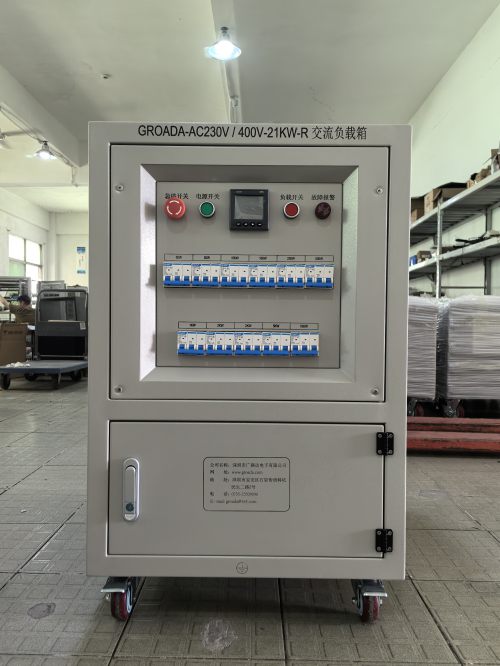
Our compact resistive suitcase model is built for the technician who works alone. Rated typically from 30 kW to 100 kW, it packs stainless-steel resistive elements, forced-air cooling, and a full digital metering panel into a wheeled, weather-resistant enclosure that one person can move and connect in minutes. The integrated controller displays voltage, current, frequency, and total kW in real time, while step-load switches allow the operator to apply load in precise increments to observe transient recovery.
Key advantages include a low profile that clears standard doorways, protected cam-lock or lug terminals for fast cable connection, and automatic over-temperature and reverse-airflow protection. Because it is purely resistive at unity power factor, it is ideal for exercising diesel generators to burn off wet stacking and to confirm nameplate kW output. This is the model most rental companies deploy first because it covers the widest range of routine field jobs.
2. Combined Resistive-Reactive Portable Unit — Testing Under Real-World Power Factor
Real electrical loads are rarely purely resistive. Motors, transformers, and inductive equipment create lagging power factor conditions that stress a generator's alternator far more than a resistive load alone. Our combined resistive-reactive portable load bank adds switchable inductive load stages, allowing you to test at 0.8 power factor lagging—the standard rating point for most generator sets.
Housed in a compact skid or trolley frame, this unit lets commissioning engineers prove that the alternator and automatic voltage regulator can maintain stable output when supplying reactive current. It is the correct tool for acceptance testing where the specification demands full kVA verification rather than kW alone. Despite the added inductive banks, careful thermal and airflow engineering keeps the footprint small enough for on-site use, and the reactive stages are digitally synchronised with the resistive load for smooth, repeatable loading profiles.
3. Compact DC Portable Load Bank — Batteries, UPS, and Telecom Power
Telecom rectifier plants, battery strings, and DC UPS systems require a dedicated DC load bank. Our compact DC model covers common nominal voltages such as 24 V, 48 V, 110 V, and 220 V DC, and is optimised for battery discharge capacity testing. During a controlled discharge it measures ampere-hours delivered, plots the voltage decay curve, and identifies weak cells long before they cause an outage.
Lightweight construction and a carry-handle or small trolley design make it easy to bring directly to the battery room. Constant-current and constant-power test modes, adjustable cut-off voltage, and data logging via USB or software let field teams produce complete capacity reports on the spot. For any operator responsible for critical backup batteries, this compact DC unit turns a guessing game into a documented measurement.
4. Rugged Outdoor Portable Load Bank — High Ingress Protection for Harsh Sites
Wind farms, mining sites, offshore platforms, and construction projects expose test equipment to dust, rain, and vibration. Our rugged outdoor portable load bank is engineered with a high-IP enclosure, corrosion-resistant coatings, and top-mounted exhaust to keep hot air clear of personnel and adjacent equipment. Available in higher ratings while remaining transportable, it bridges the gap between a true portable unit and a stationary load bank.
Remote operation is a standout feature: an operator can control loading and monitor readings from a safe distance using a handheld controller or laptop, which is essential when testing on scaffolded rooftops or inside noisy plant rooms. Lifting points, forklift channels, and lockable panels support safe handling and secure overnight storage on active sites.
How to Choose the Right Compact Load Bank
Selecting the correct portable load bank comes down to four questions. First, what type of source are you testing—AC generator, UPS, or DC battery? This determines resistive, reactive, or DC construction. Second, what is the rated power and voltage of the equipment? Always choose a load bank that can reach at least the full nameplate rating with headroom. Third, what power factor does the specification require? If it demands kVA testing, a resistive-only unit is not enough. Fourth, what are the site conditions? Indoor plant rooms favour a quiet suitcase model, while exposed outdoor sites demand a high-IP rugged design.
Cooling capacity, metering accuracy, connection type, and data-logging capability should also weigh into the decision. A slightly larger investment in integrated metering and remote control pays for itself in faster, safer, better-documented tests.
Safety and Best Practice in the Field
Every load test releases significant heat. Position the unit so exhaust air cannot recirculate into the intake or blow toward people. Verify cable ratings and torque all connections before energising. Apply load in steps, allow the source to stabilise at each stage, and never exceed the equipment's rated output. Keeping a clear exhaust path and following the manufacturer's warm-up and cool-down sequence protects both the load bank and the equipment under test.
Conclusion
Compact portable load banks make genuine, standards-compliant testing possible anywhere your equipment is installed. Whether you need the everyday versatility of a resistive suitcase model, the true power-factor accuracy of a resistive-reactive unit, the diagnostic precision of a DC battery tester, or the durability of a rugged outdoor design, choosing the right tool ensures every generator, UPS, and battery system performs exactly as promised. As a dedicated load bank manufacturer, we build each of these units for the demands of real field work—portable, precise, and ready for on-site testing.