
In modern power testing, backup generation, and energy storage validation, the load bank has evolved from a simple heat-dissipating resistor rack into an intelligent measurement platform. As data centers, renewable microgrids, and marine power systems demand ever-tighter tolerances, engineers can no longer rely on crude load application alone. They need instruments that apply load precisely, capture data continuously, and calibrate results against traceable references. This article benchmarks seven intelligent load banks that stand out for precise data calibration, and explains what separates a truly measurement-grade device from a basic load simulator.
Why Data Calibration Matters in Load Testing
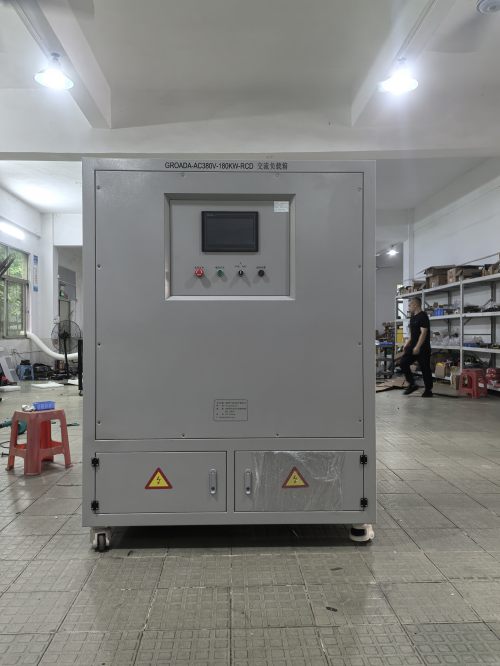
A load bank verifies whether a power source can deliver rated output under controlled conditions. But the value of that test depends entirely on the accuracy of the measured data. If voltage, current, power factor, and frequency readings drift, the entire commissioning report becomes unreliable. Poorly calibrated load banks can mask underperforming generators or, conversely, condemn healthy equipment. For mission-critical facilities, a calibration error of even one percent can translate into thousands of dollars in unnecessary maintenance or, worse, an undetected failure during an actual outage.
Intelligent load banks address this by integrating high-resolution sensors, digital signal processing, and self-diagnostic routines. Many now embed load cells and precision current transformers whose outputs are traceable to national metrology standards. This traceability is what allows a test report to withstand third-party audit and regulatory scrutiny.
Benchmarking Criteria
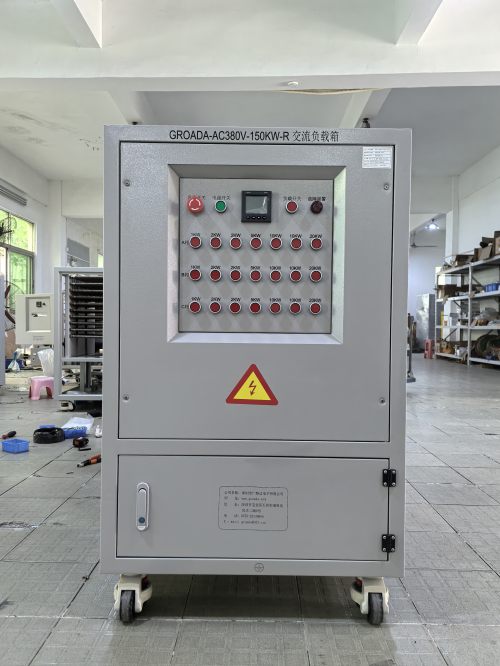
To rank the seven units fairly, we evaluated each against a consistent set of engineering parameters:
- Measurement accuracy: the rated tolerance of voltage, current, and power readings, expressed as a percentage of full scale.
- Calibration traceability: whether the instrument ships with a certificate traceable to recognized standards and supports field re-calibration.
- Resolution and sampling rate: how finely and how frequently the device captures transient behavior.
- Load step control: the granularity with which load can be applied and removed.
- Data logging and connectivity: onboard storage, export formats, and remote monitoring capability.
- Thermal and environmental stability: how well accuracy holds across the operating temperature range.
1. Precision Resistive Load Bank with Integrated Metering
The first benchmark unit is a purely resistive load bank engineered for generator commissioning. Its standout feature is an integrated power analyzer with a stated accuracy of ±0.2 percent of reading. Sensing is handled by shunt-based current measurement combined with true-RMS voltage acquisition, ensuring that non-sinusoidal waveforms are captured faithfully.
Load steps are selectable in fine increments, allowing engineers to walk a generator through its full duty curve while logging fuel consumption and temperature rise. The onboard data logger records at high sample rates, capturing the load-acceptance transient that reveals governor response quality. For calibration, the unit stores a factory certificate and supports periodic verification against an external reference meter, making it a dependable choice for facilities that require documented traceability.
2. Resistive-Reactive Load Bank for Power Factor Testing
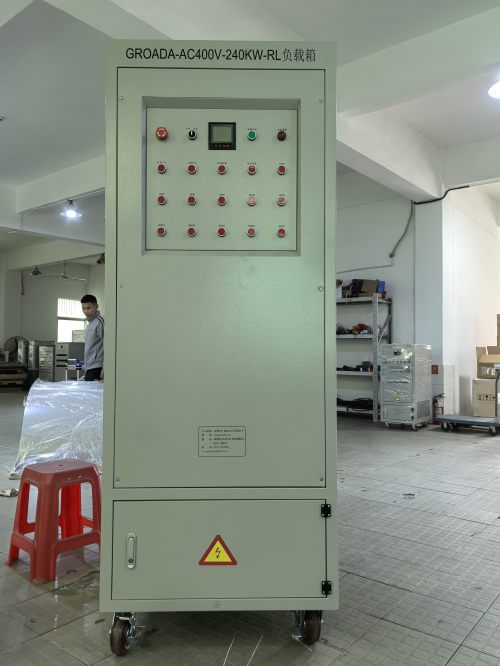
Real-world loads are rarely purely resistive. This second unit combines resistive and inductive elements so that generators and UPS systems can be tested at realistic lagging power factors, typically down to 0.8. The intelligence lies in its automatic power-factor regulation: the controller adjusts reactive elements in real time to hold a commanded power factor while the resistive bank holds real power constant.
Its measurement subsystem cross-checks apparent, real, and reactive power, and flags any inconsistency that would indicate a sensor drift. This redundancy is valuable for calibration confidence because a single faulty channel becomes immediately visible. Data is exported in open formats, letting engineers import readings into their own analysis pipelines without proprietary lock-in.
3. Regenerative Load Bank with Bidirectional Metering
Regenerative load banks return absorbed energy to the grid rather than dissipating it as heat, dramatically reducing test-cell cooling requirements. The benchmark model in this category uses power-electronic converters with bidirectional current sensors, enabling accurate measurement in both charge and discharge directions. This makes it ideal for battery cycling and energy-storage validation, where the same instrument must measure energy flowing out of and back into a device under test.
Because power electronics can introduce measurement noise, this unit applies digital filtering and synchronized sampling locked to the line frequency. The result is stable, repeatable readings even during rapid load reversals. Its calibration routine compensates for converter losses, so the reported energy reflects what the device under test actually delivered, not what the converter consumed.
4. Portable Load Bank with Wireless Data Acquisition
Field service teams need accuracy without bulk. This portable unit packs a calibrated measurement core into a transportable enclosure and streams data over a secure wireless link to a tablet or laptop. Despite its size, it maintains a respectable ±0.5 percent measurement tolerance and includes temperature-compensated sensing to preserve accuracy across outdoor conditions.
The wireless interface is more than a convenience. It allows the operator to stand clear of energized equipment while still observing live data, improving safety during high-current tests. All captured data is timestamped and stored locally as a backup, so a dropped connection never means lost calibration records.
5. High-Capacity Load Bank for Data Center Commissioning
Large hyperscale facilities require multi-megawatt load application, and this benchmark unit scales accordingly. Multiple load modules operate in parallel under a master controller that balances current sharing and aggregates measurements into a single coherent dataset. Precise data calibration at this scale depends on synchronizing dozens of sensors so that their readings represent one instant in time.
The controller performs automatic sensor cross-calibration at startup, comparing each module against the others to detect outliers. During integrated systems testing, this load bank simulates the phased ramp-up of IT load, letting commissioning agents verify that cooling, switchgear, and generators respond correctly. The comprehensive logs it produces form the backbone of the facility's acceptance documentation.
6. DC Load Bank for Battery and Renewable Systems
As solar arrays, fuel cells, and battery banks proliferate, DC load testing has become essential. This unit specializes in constant-current, constant-power, and constant-resistance modes, each requiring precise regulation and measurement. Its four-wire Kelvin sensing eliminates lead-resistance errors, a common source of inaccuracy in DC measurement, delivering readings that reflect true terminal voltage.
For calibration, the device includes a built-in reference that it checks against on every power cycle, alerting the operator if drift exceeds a set threshold. Programmable test profiles let engineers replicate discharge curves and capacity tests with repeatable precision, producing data suitable for warranty validation and performance benchmarking.
7. Modular Smart Load Bank with Cloud Analytics
The final benchmark represents where the technology is heading. This modular system combines resistive and reactive stages, bidirectional metering, and an embedded computer that pushes calibrated data to a cloud analytics platform. Engineers can compare current results against historical baselines automatically, spotting slow degradation that a single test might miss.
Its measurement chain is certified to tight tolerances, and the platform maintains a digital calibration history for every sensor, complete with expiry alerts. This transforms calibration from a periodic chore into a continuously monitored state, ensuring that every test performed is backed by a verifiably in-date measurement system.
The Role of Load Cells and Precision Sensors
Underlying every intelligent load bank on this list is a network of precision sensors. Current transformers, voltage dividers, temperature probes, and in some mechanical test rigs, load cells, all contribute to the final data. A load cell measuring mechanical force must exhibit low hysteresis, high repeatability, and stable temperature behavior, and the same principles apply to electrical sensing elements. The quality of these transducers determines the ceiling of achievable accuracy; no amount of software can compensate for a fundamentally noisy or drifting sensor.
This is why leading manufacturers pair their load banks with sensors that are individually characterized and traceable. When a sensor's response is fully mapped, the controller can apply correction factors that squeeze out systematic errors, delivering calibrated results that hold across the full operating range.
Choosing the Right Load Bank for Your Application
Selecting among these benchmarked units comes down to matching capability to purpose. For generator acceptance testing, a resistive-reactive unit with power-factor control provides the most realistic validation. For energy storage, a bidirectional or DC-focused load bank is essential. Facilities pursuing sustainability goals will favor regenerative designs, while field teams prioritize portability and wireless data capture. Large data centers demand scalable, high-capacity platforms with synchronized metering.
Regardless of category, the constant requirement is precise, traceable data calibration. An intelligent load bank is only as trustworthy as the numbers it reports, and those numbers are only meaningful when backed by certified sensors and disciplined calibration practices.
Conclusion
The seven intelligent load banks benchmarked here illustrate how far load testing has advanced. By embedding high-accuracy sensing, automated calibration, and rich data connectivity, these instruments give engineers the confidence to certify power systems against demanding standards. As the electrical landscape grows more complex with renewables and storage, the ability to apply load precisely and measure it accurately will remain a cornerstone of reliable power engineering. Investing in a well-calibrated, intelligent load bank is ultimately an investment in the integrity of every test result it produces.