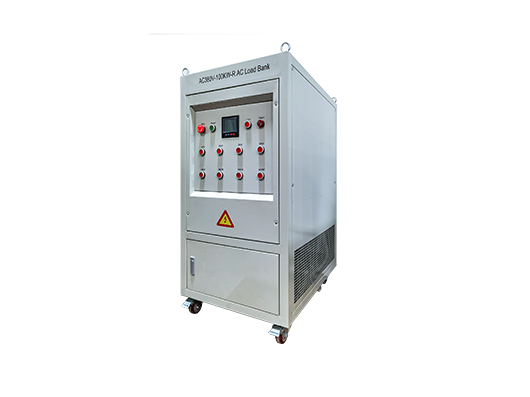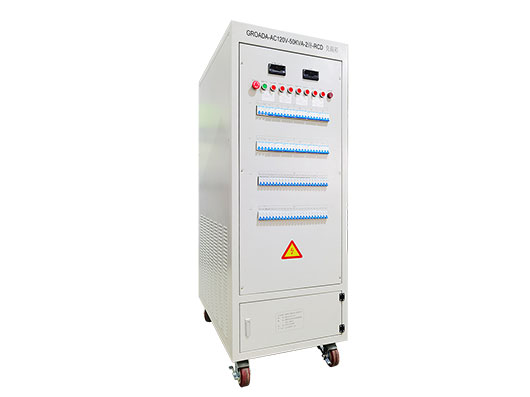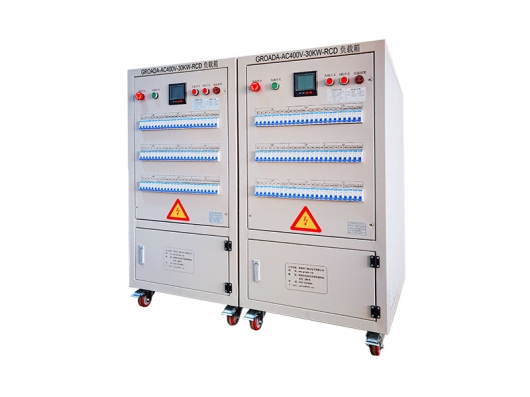
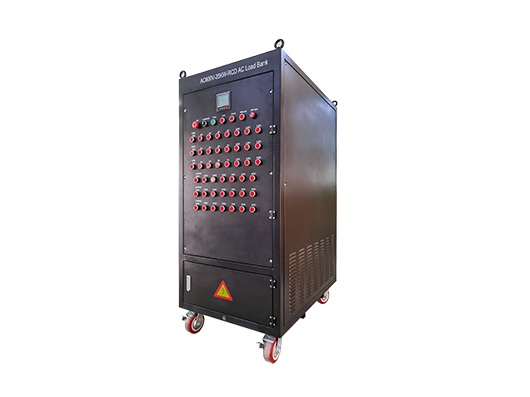
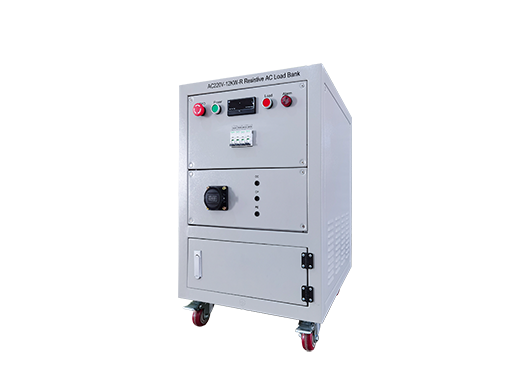
Product images are provided for visual reference. Please confirm the final configuration and specifications with our team.
Industrial Testing Equipment
GROADA-AC220V-12KW-R resistance load bank
Explore product details and technical information, or send us your requirements for application guidance and a quotation.
Request Product Information
Tell us what you need. Our team can follow up with product details and quotation information.
Product Overview & Technical Specifications
| Model | AC220V-6KW-R | AC380V-30KW-R | AC380V-60KW-R | AC380V-100KW-R | AC380V-200KW-R | AC380V-400KW-R | AC380V-500KW-R | AC380V-1000KW-R |
| Rated power | 0-6KW | 0-30KW | 0-60KW | 0-100KW | 0-200KW | 0-400KW | 0-500KW | 0-1000KW |
| Size (width * depth * height mm) | 480*600*277 | 500*750*1000 | 600*850*1000 | 600*850*1400 | 700*1000*1650 | 1100*1400*1700 | 1100*1400*1800 | 1500*1800*2000 |
| Weight | 25KG | 80KG | 130KG | 180KG | 250KG | 550KG | 650KG | 1100KG |
| Input current | 0-30A | 0-45A | 0-90A | 0-150A | 0-300A | 0-600A | 0-750A | 0-1500A |
| Minimum loading | 100W | 100W | 500W | 1KW | 1KW | 5KW | 10KW | 50KW |
| Other minimum loading power can be customized according to requirements | ||||||||
| Input voltage | AC220/230V | AC380/400V | ||||||
| Other input voltage can be customized according to requirements | ||||||||
| Power | PF=1.0 | |||||||
| Overall accuracy | 3% (other accuracy requirements can be customized according to requirements) | |||||||
| Control mode | Local manual/remote host computer (local manual control mode: circuit breaker/button/touch screen three-way optional, other methods can be customized as required) | |||||||
| Remote Interface | RS232/RS485/USB/RJ45/CAN/GPIB (other interface modes can be customized according to requirements) | |||||||
| Protection function | Emergency stop protection, over-temperature protection, fan load interlock protection, grounding protection (select over-voltage protection, over-current protection, short-circuit protection, fan overload, insufficient air volume) | |||||||
| Working power supply | AC220V | AC220V/380V | AC380V | |||||
| Display accuracy | 0.5 level (other explicit precision can be customized according to requirements | |||||||
| Display parameters | Voltage, current, power, frequency, power factor, etc. (other explicit methods can be customized according to requirements) | |||||||
| Cold sure way | Forward and out | Side air inlet and upper air outlet (other air outlet methods can be customized according to requirements) | ||||||
| Protection level | IP20 (other protection level can be customized according to requirements) | |||||||
| Appearance color | RAL7035 (other colors can be customized according to requirements) | |||||||
| Working temperature | -10 ℃ ~ 55 ℃ | |||||||
| Relative humidity | ≤95%RH | |||||||
| Altitude | ≤ 2500 m | |||||||
GROADA AC220V 12KW Resistive Load Bank: Comprehensive Overview for Power System Testing
🔌 Product Overview
The GROADA AC220V 12KW Resistive Load Bank is a high-precision testing device engineered to simulate real-world electrical loads, ensuring the reliability and efficiency of power systems. Manufactured by GROADA, a leading provider of power testing solutions, this load bank is essential for validating the performance of generators, uninterruptible power supplies (UPS), and other critical electrical equipment.
⚙️ Key Specifications
-
Rated Power: 12KW
-
Rated Voltage: AC220V
-
Frequency: 50/60Hz
-
Load Type: Resistive
-
Cooling Method: Industrial-grade axial fan
-
Control Modes: Local manual control panel, remote control via PC or notebook
-
Safety Features: Overvoltage, overcurrent, overtemperature, and fan failure protection
-
Applications: Generator sets, UPS systems, inverters, battery systems, and other power equipment
🛠️ Applications
The 12KW resistive load bank is versatile and can be utilized in various scenarios:
-
Generator Testing: Ensures that generators can handle full-rated loads, preventing issues like wet stacking and carbon build-up, which can degrade engine performance over time.
-
UPS Systems Validation: Verifies the capacity and autonomy of UPS batteries, ensuring they can provide uninterrupted power during outages.
-
Data Center Operations: Simulates real-world conditions to ensure that backup power systems can handle peak loads without failure.
-
Renewable Energy Integration: Tests inverters and other components to ensure they can handle varying loads and conditions.
✅ Benefits
-
Enhanced Equipment Longevity: By identifying and rectifying potential issues early, load bank testing helps extend the lifespan of critical power equipment.
-
Cost Savings: Preventing unexpected failures through regular testing can lead to significant cost savings by avoiding expensive repairs and downtime.
-
Compliance Assurance: Regular load bank testing ensures that power systems meet industry standards and regulatory requirements, mitigating the risk of non-compliance.
-
Operational Confidence: Provides assurance that power systems will perform optimally during critical situations, reducing the risk of power outages and equipment failures.
🧪 Testing Procedures
Load bank testing involves applying a controlled load to the power system under test to simulate real operating conditions. The process includes:
-
Preparation: Ensure that the power system is properly connected and all safety measures are in place.
-
Load Application: Gradually apply the resistive load to the system, monitoring parameters such as voltage, current, and temperature.
-
Monitoring: Continuously monitor the system's performance, looking for any signs of stress or malfunction.
-
Evaluation: Assess the system's ability to handle the applied load and identify any areas for improvement.
This comprehensive testing approach ensures that power systems can operate reliably under full load conditions.
📈 Industry Insights
According to industry experts, regular load bank testing is crucial for maintaining the health of power systems. It helps in identifying mechanical issues that could escalate, ensuring that generators can sustain operations at full load for extended periods.
Furthermore, load bank testing is an integral part of any facility that relies on generators. It helps in exercising the generator, preventing issues like wet stacking, and ensures that the generator can handle full-rated loads, thereby avoiding costly downtime caused by a faulty generator.
🔍 Conclusion
The GROADA AC220V 12KW Resistive Load Bank is an indispensable tool for ensuring the reliability and efficiency of power systems. By simulating real-world load conditions, it provides valuable insights into the performance of generators, UPS systems, and other critical equipment. Investing in regular load bank testing is a proactive approach to maintaining the health of power systems, ensuring they perform optimally when needed most.