
Load bank equipment plays a critical role in ensuring the reliability, safety, and performance of electrical power systems—from generators and transformers to backup power supplies and renewable energy installations. These devices simulate real-world electrical loads to test how power sources behave under various conditions without actually consuming energy from the grid. This is essential for commissioning new systems, validating maintenance procedures, and preventing costly failures in industrial, commercial, and utility-scale applications.
Load banks are categorized primarily by their load type: resistive, inductive, capacitive, or a combination (e.g., resistive-inductive). Resistive load banks are the most common and are used to test generators’ ability to handle steady-state loads, such as lighting or heating systems. Inductive load banks mimic motors and transformers, testing reactive power capabilities, while capacitive load banks help assess voltage regulation in systems with high inductance. Modern load banks often combine multiple load types to provide comprehensive validation of generator performance across different power factor scenarios.
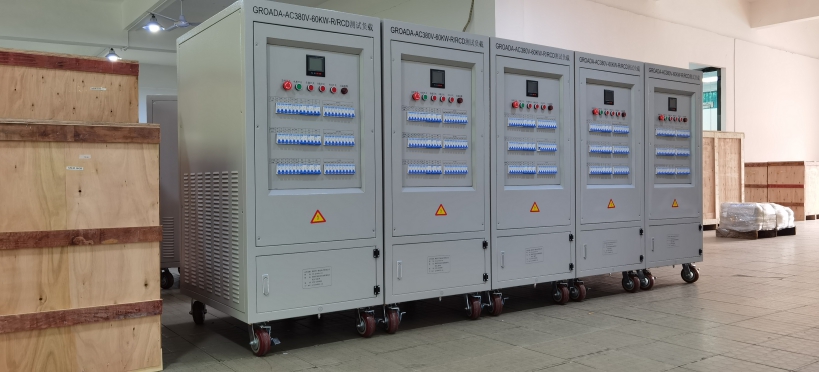
The design and manufacturing of load banks involve rigorous engineering standards, including IEEE 1547 for distributed energy resources, IEC 60034 for electric machine testing, and UL/CSA standards for safety compliance. High-quality load banks must meet thermal management requirements, maintain stable impedance over time, and support remote monitoring via digital interfaces like Modbus or Ethernet. For example, in a case study involving a 5 MW diesel generator at a remote mining site, a custom-built resistive-inductive load bank enabled full-load testing over 72 hours, identifying a governor response issue that would have otherwise led to downtime during peak operations.
In addition to static load testing, modern load banks now integrate with power quality analyzers and data logging systems to monitor parameters such as harmonics, voltage sags, frequency stability, and transient response. This allows engineers to validate compliance with international standards like EN 50160 (voltage characteristics) and IEEE 1159 (power quality metrics). The use of intelligent load banks in renewable energy projects—such as solar farms or wind turbines—is also growing rapidly, where they are used to simulate variable loads during grid integration testing.
Manufacturers must ensure robust mechanical construction using materials like stainless steel, aluminum, and heat-resistant alloys to withstand continuous operation at high temperatures. Many units are air-cooled, while larger systems may employ water cooling for enhanced efficiency. Portable load banks are increasingly popular in field service applications due to their ease of transport and modular design, enabling rapid deployment for mobile testing teams.
As global demand for reliable power increases—with rising adoption of microgrids, EV charging infrastructure, and smart grid technologies—the role of load bank equipment will continue to expand. Engineers, facility managers, and utility operators rely on these tools not only for pre-commissioning checks but also for predictive maintenance, performance benchmarking, and regulatory compliance. Investing in advanced load bank technology ensures operational resilience, reduces risk, and supports the transition toward smarter, more sustainable energy systems worldwide.