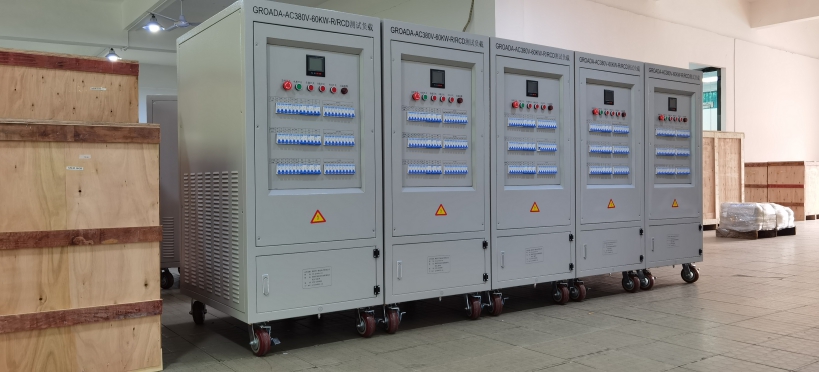
Portable load banks are essential tools for validating the performance and reliability of generators, especially in remote or mobile applications such as construction sites, emergency response units, and off-grid power systems. These devices simulate real-world electrical loads to test generator output under various conditions—ensuring that the equipment can handle full capacity without overheating, voltage drop, or mechanical stress. A well-designed portable load bank includes resistive, reactive, or combined RLC (resistance-inductance-capacitance) elements to accurately replicate different types of loads found in industrial, commercial, and utility environments. For example, a resistive load bank primarily tests the generator’s ability to deliver active power, while a reactive load bank assesses its capability to manage inductive or capacitive currents—critical for maintaining stable voltage during variable power factor operation.
Modern portable load banks often feature advanced controls like Modbus RTU or Ethernet interfaces for remote monitoring, allowing engineers to log data over time and analyze parameters such as power factor, frequency stability, and temperature rise. Safety features—including overtemperature protection, short-circuit detection, and emergency stop functionality—are built into compliant models to meet IEC 60034-1 and IEEE standards for electrical safety. Cooling is typically achieved through forced-air systems with adjustable fan speeds, ensuring efficient heat dissipation even at 100% rated load for extended periods. Mechanical design emphasizes durability and portability, with IP54-rated enclosures, lifting eyes, and fork-lift pockets enabling easy transport across rugged terrain.
In an anonymized case study from a mining site in Australia, a 250 kW three-phase portable load bank was used to perform factory acceptance testing (FAT) on a diesel generator before deployment. The generator failed initial tests due to excessive voltage regulation issues under reactive loading, prompting modifications to the AVR (Automatic Voltage Regulator). After retesting with the same load bank, the unit passed all performance benchmarks, including continuous 8-hour runs at 90% load. This demonstrates how load testing not only verifies compliance but also identifies potential failures before they impact operations.
By integrating precise measurement accuracy (±0.5% for voltage, current, and power), user-friendly control panels, and robust thermal management, portable load banks have become indispensable assets for engineers involved in generator commissioning, maintenance, and grid integration projects worldwide.