
Portable load banks are essential tools for testing the performance, reliability, and safety of generators, UPS systems, and renewable energy installations such as wind farms or solar inverters. Unlike fixed load banks used in laboratories or factory settings, portable models provide flexibility for on-site validation—critical for commissioning new power systems, performing routine maintenance, or simulating real-world electrical loads before grid connection.
A typical portable resistive load bank dissipates electrical energy as heat through precision-engineered resistor blocks, allowing accurate simulation of active power (kW) demands. These units often feature three-phase configurations (380V/480V AC) with current ratings from 100A to 500A per phase and power ranges up to 250 kW. For more complex applications involving reactive power (kVAR), combination RLC load banks integrate inductive and capacitive components to mimic motor-driven or electronic loads—enabling comprehensive testing of generator voltage regulation and power factor correction.
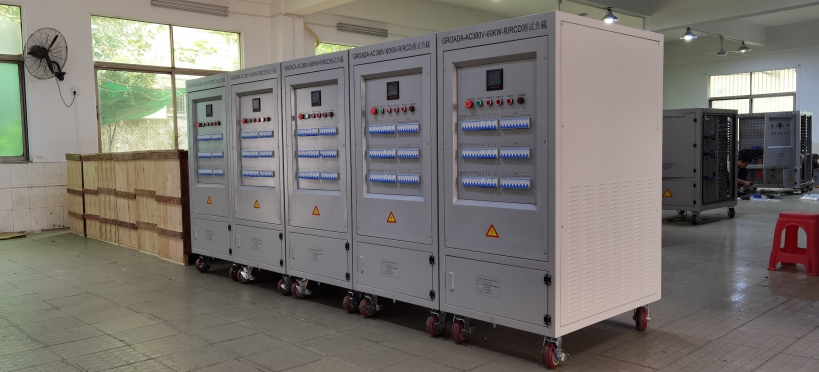
Modern portable load banks include remote control via Modbus RTU or Ethernet, enabling automated load cycling and data logging for compliance with IEC 60034-1 standards for generator testing. Thermal protection circuits prevent overheating, while built-in digital meters measure voltage, current, active/reactive power, and power factor in real time with ±1% accuracy. CE/UL/CCC certification ensures safe operation across international markets, and IP54-rated enclosures protect against dust and water ingress during outdoor use.
Case studies show that portable load banks reduce generator downtime by up to 40% when used in pre-commissioning checks at construction sites. In one anonymized case, a 200 kW diesel generator was tested using a portable resistive load bank over 4 hours at 75% rated load, revealing an unexpected voltage dip under sudden load steps—a fault corrected before site handover. Another simulated example demonstrated how a 150 kVA three-phase reactive load bank helped validate a microgrid’s ability to maintain stable frequency during rapid load changes.
These devices support both field technicians and engineers in ensuring system integrity—making them indispensable in industrial, military, and off-grid power environments where reliability cannot be compromised.









