
Load bank testing is a critical procedure used to verify the performance, reliability, and safety of electrical power sources such as generators, UPS systems, and renewable energy inverters. By simulating real-world electrical loads, load banks ensure that these systems can handle their intended operational demands without failure. This process is essential in both factory acceptance testing (FAT) and on-site commissioning phases across industries including data centers, hospitals, manufacturing, and off-grid energy projects.
A resistive load bank primarily draws active power from the system, heating up internal resistor blocks to simulate pure resistive loads like lighting or heating equipment. These are widely used for generator load testing due to their simplicity and cost-effectiveness. For more complex scenarios—such as testing motors, transformers, or variable frequency drives—a reactive load bank introduces inductive or capacitive reactance, enabling tests under different power factor conditions. A combination (RLC) load bank allows engineers to emulate full-load behavior with adjustable power factor, making it ideal for comprehensive system validation.
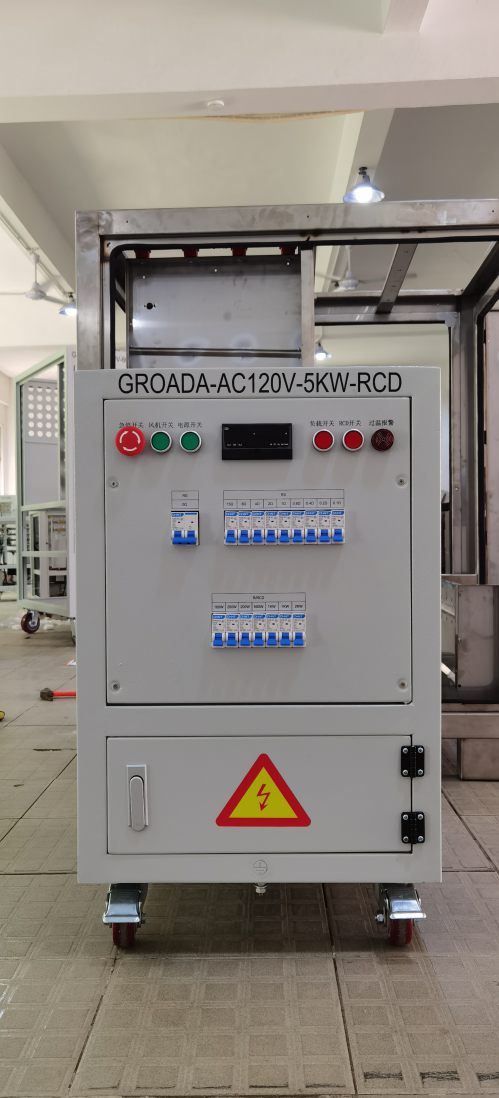
Modern portable load banks often feature digital controls, remote monitoring via Ethernet or Modbus, and automatic thermal protection. They typically operate at 400 V AC (three-phase), with ratings from 50 kW to over 1 MW depending on application size. Key parameters include voltage tolerance ±2%, current accuracy within 0.5%, and power factor adjustment ranges from 0.8 lagging to 0.8 leading. Cooling methods vary: air-cooled units use forced fans for smaller systems, while water-cooled models support high-power continuous operation in industrial environments.
Safety standards such as IEC 60034-1 (for rotating machines) and IEEE 1159 (power quality guidelines) guide design and testing protocols. Devices must comply with CE, UL, or CCC certifications based on regional markets. Mechanical construction includes IP54-rated enclosures for dust and splash resistance, along with lifting eyes and fork truck pockets for safe transport. Regular calibration every 12 months ensures measurement integrity, especially for voltage, current, and power readings.
Case Study – Anonymized Data Center Test: During commissioning of a 500 kW diesel generator, a 3-phase resistive load bank was applied incrementally up to 100% load over 4 hours. Voltage regulation remained stable at ±1.5%, and no overheating occurred despite ambient temperatures reaching 45°C. The test confirmed the generator’s ability to sustain full load continuously, aligning with IEC 60364 compliance requirements.
In summary, selecting the right type of load bank—resistive, reactive, or RLC—depends on the system being tested and its expected load profile. Proper planning, adherence to international standards, and regular maintenance ensure reliable results and long-term asset protection.